AI Secret Growth Map: July 2025
Utility Wins-July’s Fastest-Growing AI Products Solve Real Problems
Read the story Subscribe
Reporting and context on SpaceX, with a closer look at the decisions and developments that matter.
Get AI Secret’s free daily briefing, including SpaceX and the wider AI industry.

Space transport company that develops rockets and spacecraft. Coverage follows its launch systems, space infrastructure and the technology and business around them.
Reviewed 19 October 2026. Dates retain the precision of the source; retrospective disclosures are identified in the event. Combined historical financials are recast to include xAI and X; they must not be read as standalone launch or Starlink revenue.
Revenue, funding, product launches and major company events, newest first. Expand the earlier milestones for more history.
Cursor confirms joining SpaceX, adding its coding editor, models and developer platform to the combined business.
Source: CursorAxios’s July account identifies the completed June IPO and proceeds. The public financing is distinct from revenue.
Source: AxiosEarlier revenue, financing and company milestones.
The prospectus reports recast 2023, 2024 and 2025 combined revenue. Historical figures include xAI and X under common-control accounting, not only rockets and Starlink.
Source: SpaceX prospectusThe prospectus records service across 164 countries and territories. Subscriber lines measure service connections, not individual people.
Source: SpaceX prospectusThe merger brings xAI, including X, into SpaceX. The prospectus retrospectively recasts the combined financial history for the common-control transaction.
Source: SpaceX prospectusNASA’s Demo-2 mission carries two astronauts aboard Crew Dragon and Falcon 9.
Source: NASAThe initial large batch begins deployment of the broadband constellation, with the Falcon 9 booster returning to a drone ship.
Source: AxiosSpaceX lands two of the three boosters during the demonstration, expanding its reusable heavy-lift launch capability.
Source: SpaceXThe successful return to a landing pad demonstrates a key step toward reusing orbital-class boosters.
Source: NASADragon returns NASA cargo after the October resupply mission, establishing an operational service beyond demonstration flights.
Source: NASAThe successful flight follows earlier unsuccessful launches and establishes SpaceX’s first orbital capability.
Source: SpaceXTesla’s official biography of Elon Musk dates the start of SpaceX to May 2002.
Source: TeslaBriefs, articles and relevant sections, newest first. Explore older coverage below.
More coverage

Welcome to AI Secret Growth Map July 2025 Report
As we enter the second half of the year, the AI growth engine is still running hot. Just one month after Gemini topped the June charts, ChatGPT roared back in July with a staggering +325.1M new visits, reclaiming the crown in overall growth. Meanwhile, the visual AI category saw a decisive shift toward utility-first tools, AI coding welcomed a wave of lightweight new entrants, and enterprise adoption leaned deeper into specialized copilots.
At AI Secret, we’ve partnered with leading industry sources and analyzed real traffic data across millions of users to compile the July 2025 Growth Rankings. As always, this report cuts through the noise to highlight the products truly capturing user attention, adoption, and trust.
Let’s dive into the data — and the dynamics — shaping AI’s latest growth wave. 👇
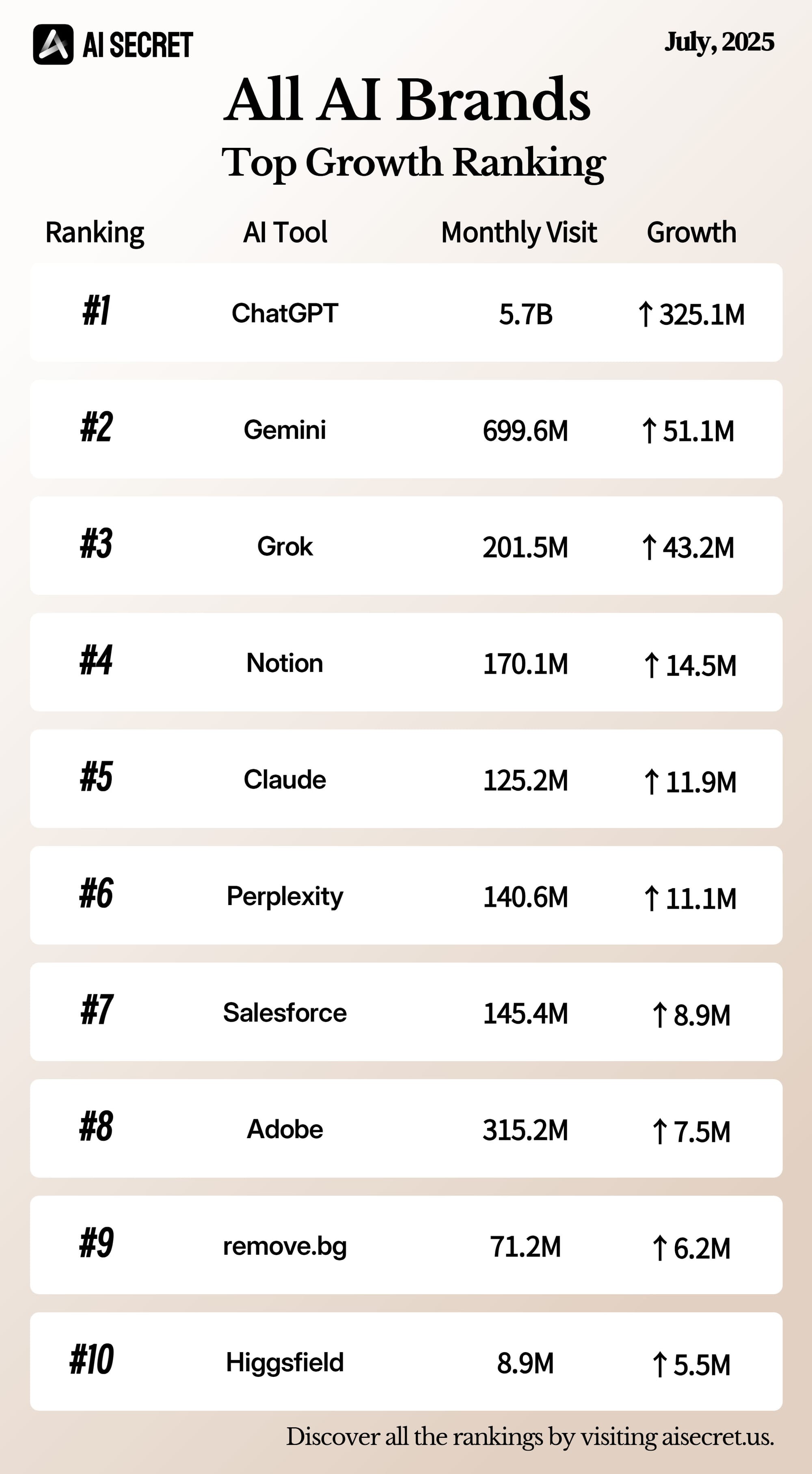
In a reversal from last month’s leaderboard, ChatGPT surged +325.1M to hit 5.7B monthly visits, retaking the growth lead from Gemini. While Gemini still grew +51.1M (to 699.6M visits), the gap this month was decisive.
The rest of the top five saw Grok (+43.2M) leapfrog Claude, with Notion (+14.5M) and Claude (+11.9M) maintaining steady climbs. Perplexity (+11.1M) held strong in the search-oriented corner of the AI stack, while Salesforce (+8.9M) and Adobe (+7.5M) underscored the stickiness of enterprise and creative platforms.
Notion's rise is fueled by its seamless integration of AI into everyday workflows — from auto-summarizing notes to generating content with context. As teams increasingly seek all-in-one workspaces, Notion's AI-native features turn it from a productivity tool into an intelligent knowledge partner.
Notably, two vertical tools — remove.bg (+6.2M) and Higgsfield (+5.5M) — entered the overall top ten, a sign that specialized offerings are gaining enough traction to break into the all-AI conversation.
🛎️ Key takeaway: The top remains anchored by generalist platforms, but July marks a clear broadening — vertical utilities are finding their way into the big leagues.
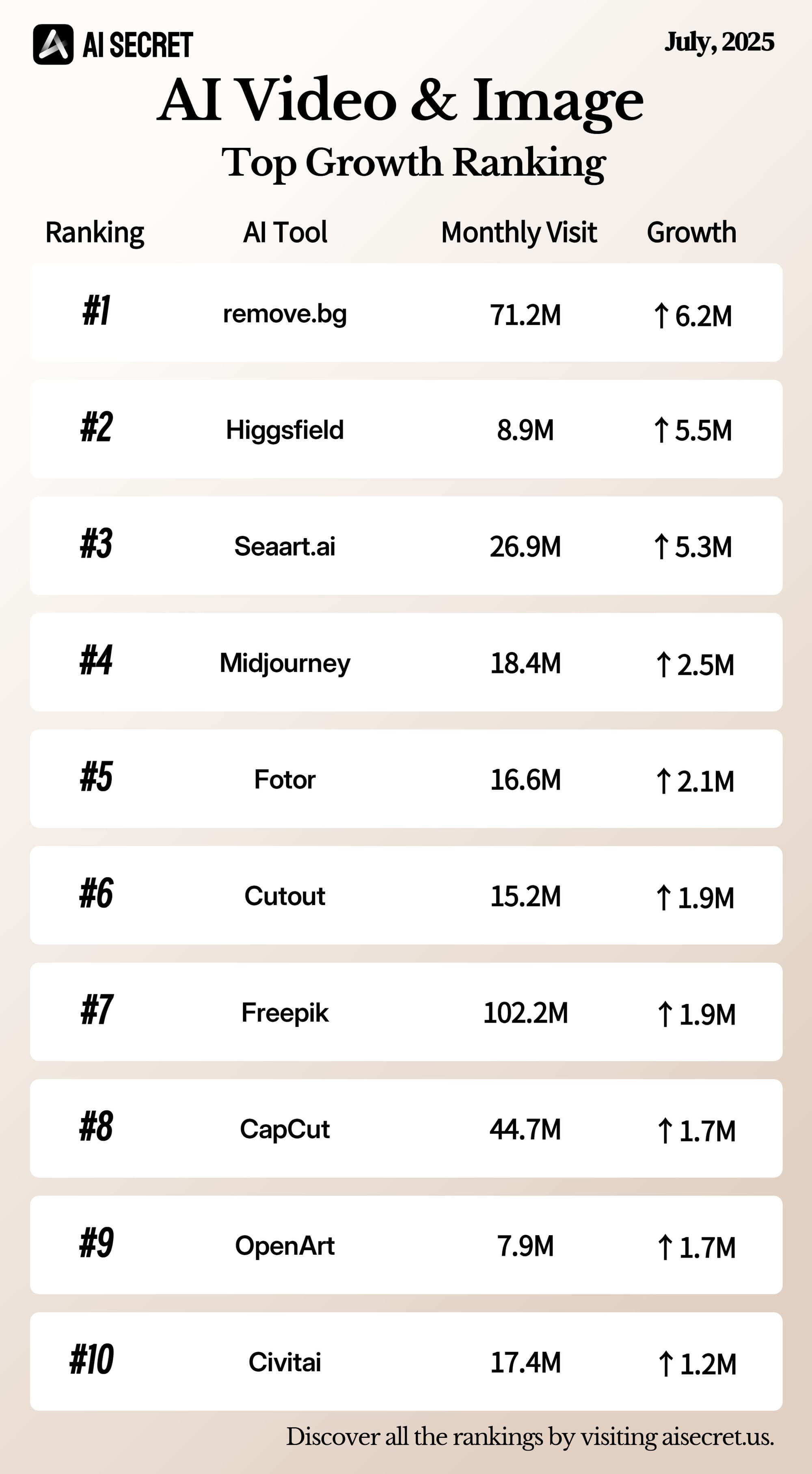
Remove.bg claimed the #1 spot this month with +6.2M growth to 71.2M visits, leveraging its straightforward, high-demand image background removal capabilities. Close behind, Higgsfield (+5.5M) and Seaart.ai (+5.3M) proved that creative tools with a clear aesthetic edge still command attention.
Newcomers like Seaart.ai are riding the wave of AI-native creativity platforms, while Midjourney (+2.5M) continued its slow but steady rise, joined by Fotor (+2.1M) and Cutout (+1.9M) in serving the needs of creators, marketers, and e-commerce workflows. Freepik, CapCut, OpenArt, and Civitai rounded out a list that blended production utility with visual artistry.
Compared to June — when cinematic newcomer Veo 3 stole the show — July’s rankings reveal a pivot toward tools that deliver immediate, practical value alongside creative potential.
🛎️ Key takeaway: When it comes to visual AI, ease-of-use trumps power. Tools that solve one thing beautifully are growing faster than do-it-all platforms.
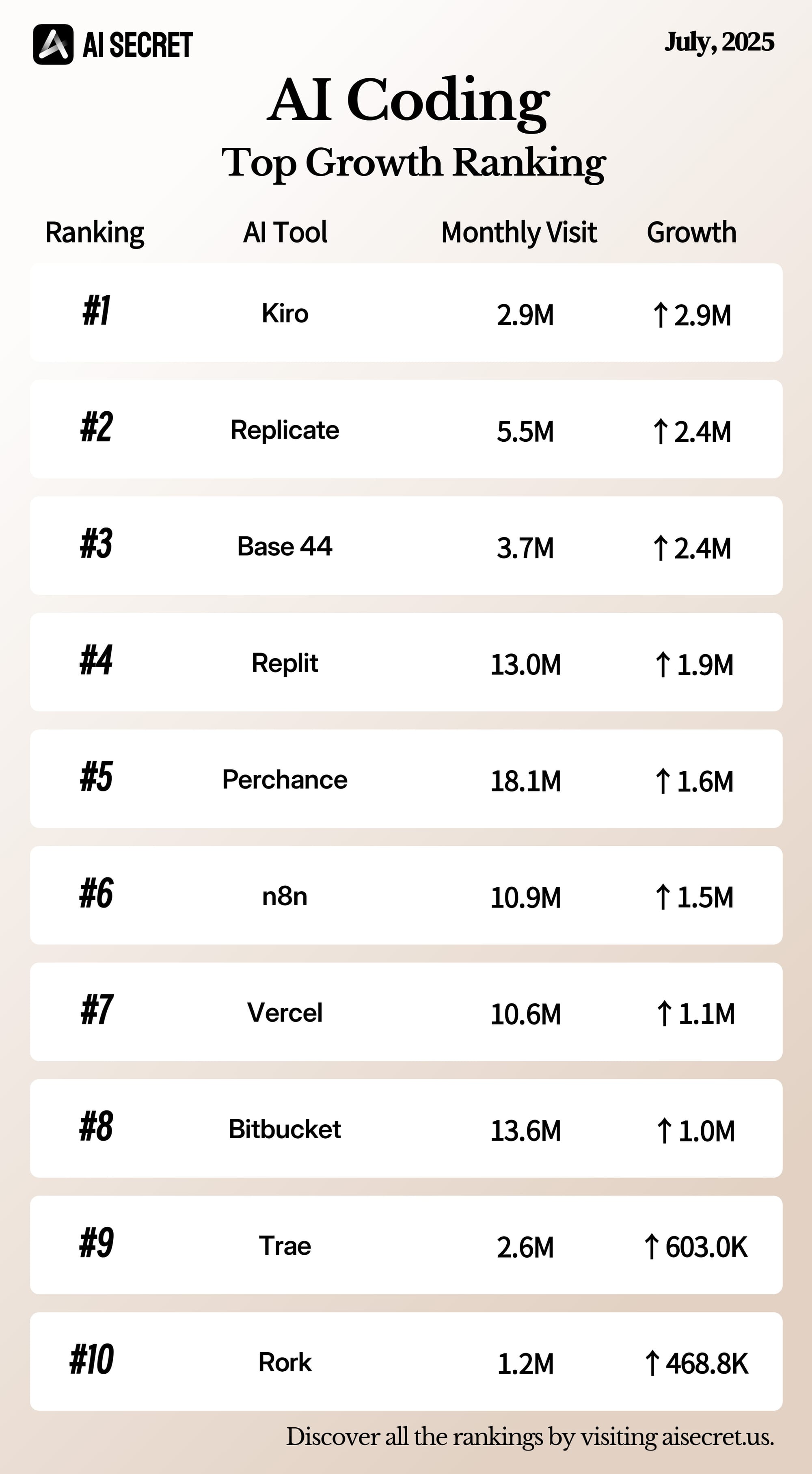
Kiro came out of nowhere to claim the #1 growth spot in coding tools with +2.9M new visits — a likely indicator of a product that fits the “copilot for X” archetype.
Replicate (+2.4M) and Base 44 (+2.4M) followed closely, showing strong demand for platforms that simplify model deployment and experimentation.
Replit (+1.9M) and Perchance (+1.6M) maintained momentum, with n8n (+1.5M), Vercel (+1.1M), and Bitbucket (+1.0M) reinforcing the backbone of the builder stack. Trae and Rork rounded out the top ten, catering to niche developer needs.
In June, Lovable ranked prominently in the AI Coding category, signaling strong early traction likely driven by buzz and initial user onboarding. However, by July, it dropped out of the top ranks — replaced by fast-rising tools like Kiro, which offer more focused, utility-driven features. This shift suggests that developer preferences are consolidating around tools with clear, task-specific value, while hype-driven products without sustained engagement are quickly overtaken.
🛎️ Key takeaway: The builder economy is fragmenting — new AI-native tools are claiming ground between traditional IDEs, scripting, and automation layers.
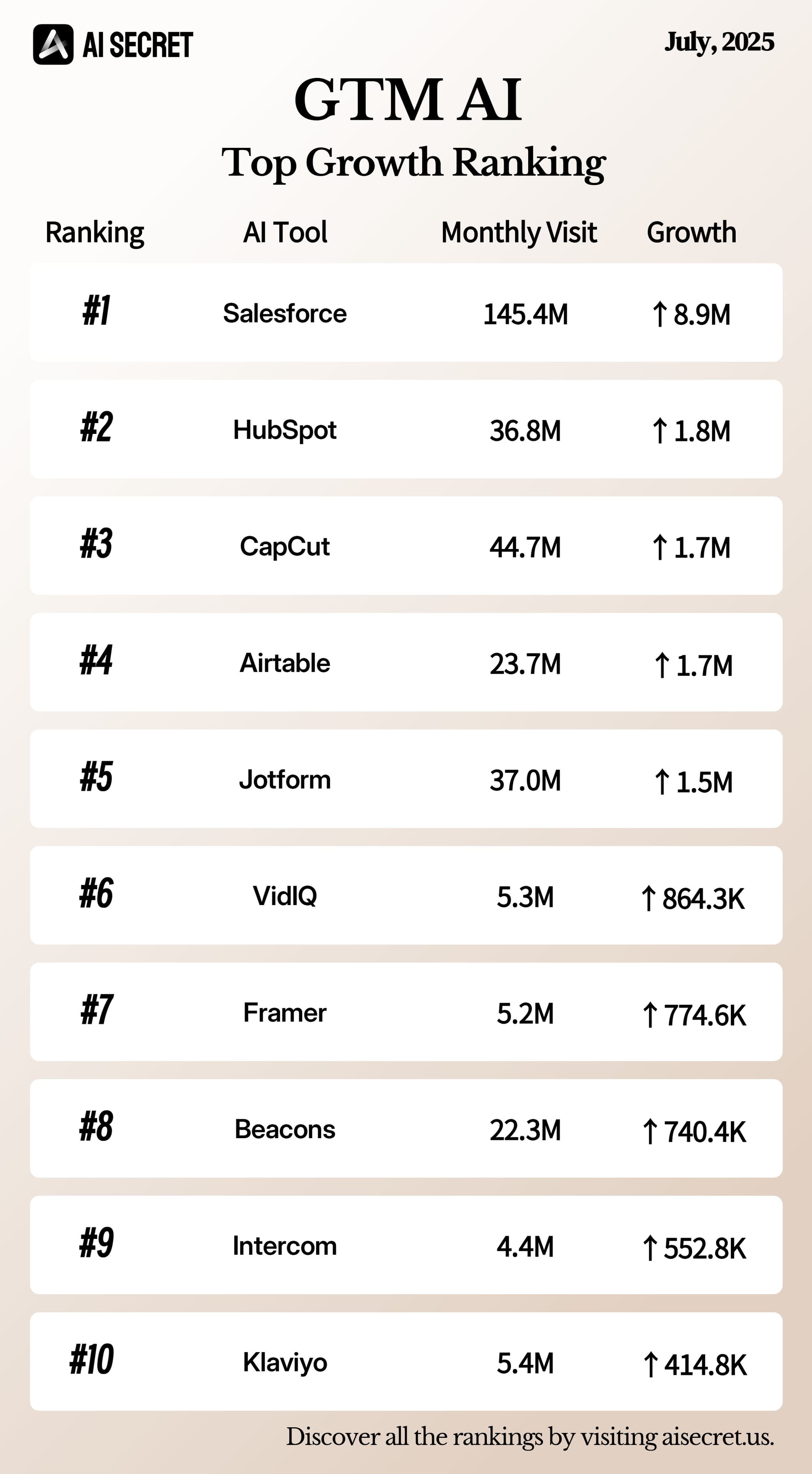
Growth teams are quietly becoming AI-first. Salesforce (+8.9M) extended its dominance, serving as the AI-powered backbone for many GTM stacks. HubSpot (+1.8M) held its ground, while Airtable added +1.7M — all layering AI across content, CRM, and operations.
VidIQ (+864.3K) and Framer (+774.6K) show that creators and marketers are embracing AI for content strategy, landing pages, and distribution.
The presence of Beacons (+740.4K), Intercom (+552.8K), and Klaviyo (+414.8K) confirms a growing demand for AI in customer engagement and funnel automation.
Compared to June, GTM AI tools in July showed a shift from core CRM platforms to creator-focused and lightweight automation tools. While Salesforce maintained its lead, tools like VidIQ, Framer, and Beacons surged up the ranks — signaling growing adoption of AI among content-driven growth teams and indie marketers.
🛎️ Key takeaway: The AI go-to-market stack is taking shape — with every touchpoint from awareness to retention getting an intelligence upgrade.
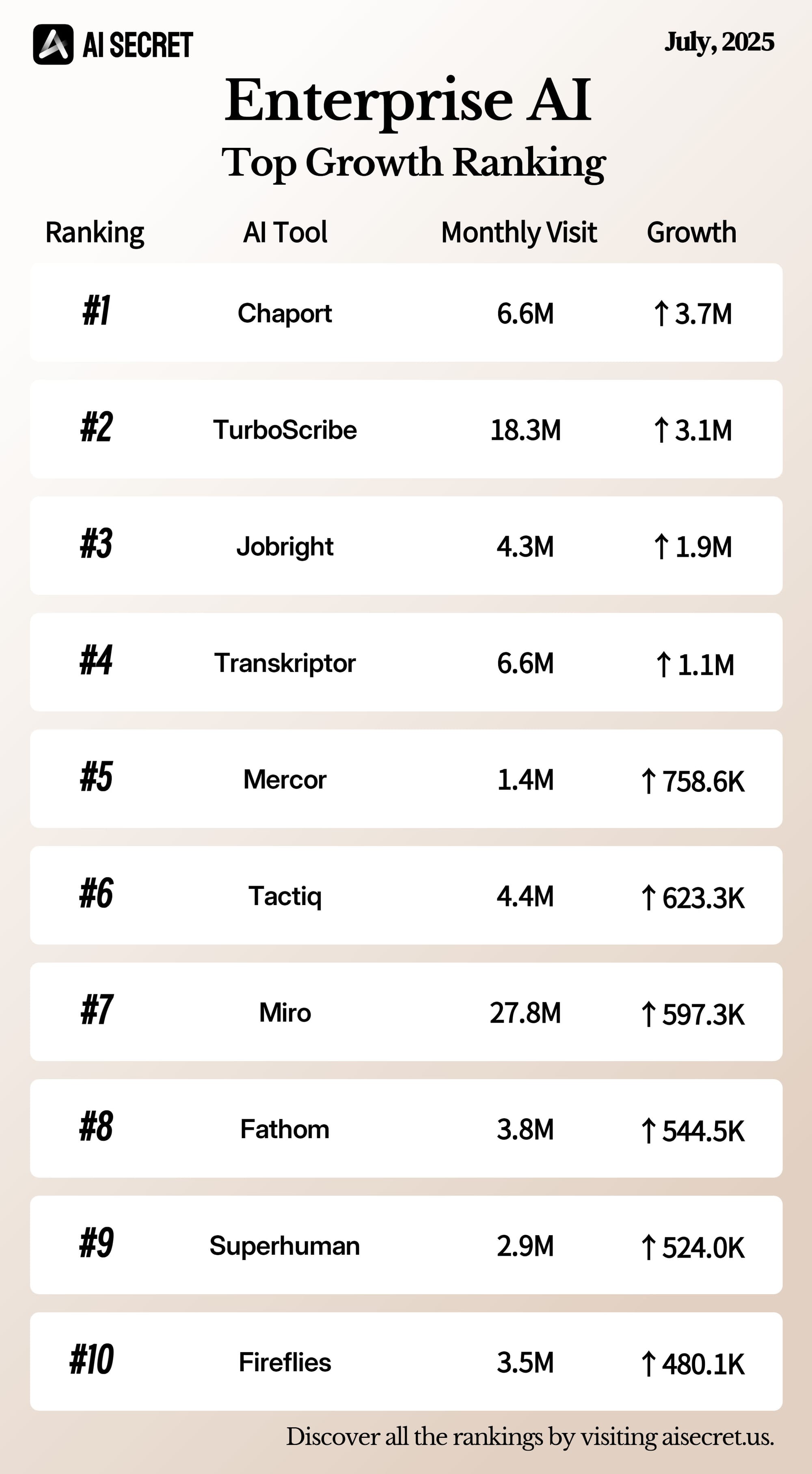
In enterprise AI, Chaport (+3.7M) took the lead. TurboScribe (+3.1M) followed, capturing the transcription and meeting note market, while Jobright (+1.9M) carved a niche in recruitment intelligence.
Transkriptor (+1.1M) and Mercor (+758.6K) joined incumbents like Miro (+597.3K), as well as Tactiq, Fathom, Superhuman, and Fireflies — all focused on solving highly specific workflow challenges.
By July, the landscape shifted toward utility-first, operational tools — with Chaport, TurboScribe, and Transkriptor rising sharply. These tools address specific, high-frequency enterprise pain points like real-time support, transcription, and team documentation.
The contrast reflects a broader trend: enterprises are moving from flashy AI add-ons to embedded, ROI-driven automation that scales quietly in the background.
🛎️ Key takeaway: The next wave of enterprise AI is quiet. It’s not flashy — it’s embedded, useful, and often invisible.
July’s data underscores that while the giants are still towering over the field, the real action is happening at the edges:
What stood out across categories?
As the AI landscape matures, utility is outperforming novelty. July’s data reveals a clear shift: users are gravitating toward tools that solve real problems quickly, whether it's coding smarter, launching faster, or automating mundane workflows. The race isn’t just about intelligence anymore — it’s about adoption at scale.
TOGETHER WITH US
AI Secret Media Group is the world’s #1 AI & Tech Newsletter Group, boasting over 1 million readers from leading companies such as OpenAI, Google, Meta, and Microsoft. Our Newsletter Brands:
We've helped promote over 500 Tech Brands. Will yours be the next?
Email our co-founder Mark directly at mark@aisecret.us if the button fails.
Related Stories
 Magna
 Magna
 Magna
 Magna

Utility Wins-July’s Fastest-Growing AI Products Solve Real Problems
Read the storyMore Stories: Claude Gets Memory, Grok 4 Waterloo
From “breakthrough” to breakdown in under 24 hours.
More Stories: ChatGPT Mall, Musk’s Baby Grok
More Stories: Google Talks Now, OpenAI’s GPU Polyamory
Your syllabus just got auto-summarized—and sold
Zuck’s Brain Buffet, Siri’s Online Coach, Musk’s Treasure Torrent
A Code Rocket, Claude Factory, Scale AI Crisis
The artificial intelligence (AI) industry is no stranger to drama, but few stories have sent as many shockwaves through Silicon Valley as Meta’s jaw-dropping $14
The establishment of Starbase, a newly incorporated city in South Texas, marks a pivotal moment in the intersection of corporate ambition, technological innovation, and urban development.