
Perplexity
Reporting and context on Perplexity, with a closer look at the decisions and developments that matter.
Get AI Secret’s free daily briefing, including Perplexity and the wider AI industry.

At a glance
Perplexity builds AI-powered search and research products. Coverage follows its answer engine, research tools and Comet browser.
- Focus
- AI search; research; Comet
- Reference
- Perplexity
Reviewed 19 October 2026. Dates retain the precision of the source; retrospective disclosures are identified in the event. Private-company ARR and financing reports are labelled as reported. Search usage is not used to estimate revenue.
Company milestones
Revenue, funding, product launches and major company events, newest first. Expand the earlier milestones for more history.
Reported ARR exceeds $450M in March
A Financial Times report, covered by Yahoo Finance, describes more than a doubling within a quarter after product and pricing changes. This is reported ARR.
Source: Yahoo Finance / Financial TimesIntroduces Perplexity Computer
The product combines research and task execution, extending Perplexity beyond its answer engine and browser.
Source: Perplexity
Show earlier milestonesHide earlier milestones2025–2022 · 7 milestones
Earlier revenue, financing and company milestones.
Reported $200M financing commitments at $20B valuation
Reuters, citing The Information, reports investor commitments. The statement is attributed and not described as independently confirmed closed proceeds.
Source: ReutersLaunches Comet
The browser adds an assistant for tasks across web pages, initially through paid access and invitations.
Source: PerplexityLaunches Perplexity Labs
Subscribers gain tools for turning research into projects such as reports, spreadsheets and dashboards.
Source: PerplexityReported ARR reaches about $200M
A later report tracing the company’s business model dates the approximately $200M recurring-revenue level to late 2025.
Source: Tom’s Guide / Financial TimesRaises $73.6M Series B
The IVP-led round supports the answer engine’s expansion, with NVIDIA and other technology investors participating.
Source: PerplexityRaises $25.6M Series A and launches its mobile app
The financing supports its conversational answer engine, following an earlier $3.1M seed round.
Source: PerplexityPerplexity is founded
The company begins developing an AI-powered answer engine that combines conversational responses with source citations.
Source: Perplexity company profile
The latest on Perplexity
Newest firstRelated reporting
Briefs, articles and relevant sections, newest first. Explore older coverage below.
More coverage

Welcome to AI Secret Growth Map July 2025 Report
As we enter the second half of the year, the AI growth engine is still running hot. Just one month after Gemini topped the June charts, ChatGPT roared back in July with a staggering +325.1M new visits, reclaiming the crown in overall growth. Meanwhile, the visual AI category saw a decisive shift toward utility-first tools, AI coding welcomed a wave of lightweight new entrants, and enterprise adoption leaned deeper into specialized copilots.
At AI Secret, we’ve partnered with leading industry sources and analyzed real traffic data across millions of users to compile the July 2025 Growth Rankings. As always, this report cuts through the noise to highlight the products truly capturing user attention, adoption, and trust.
Let’s dive into the data — and the dynamics — shaping AI’s latest growth wave. 👇
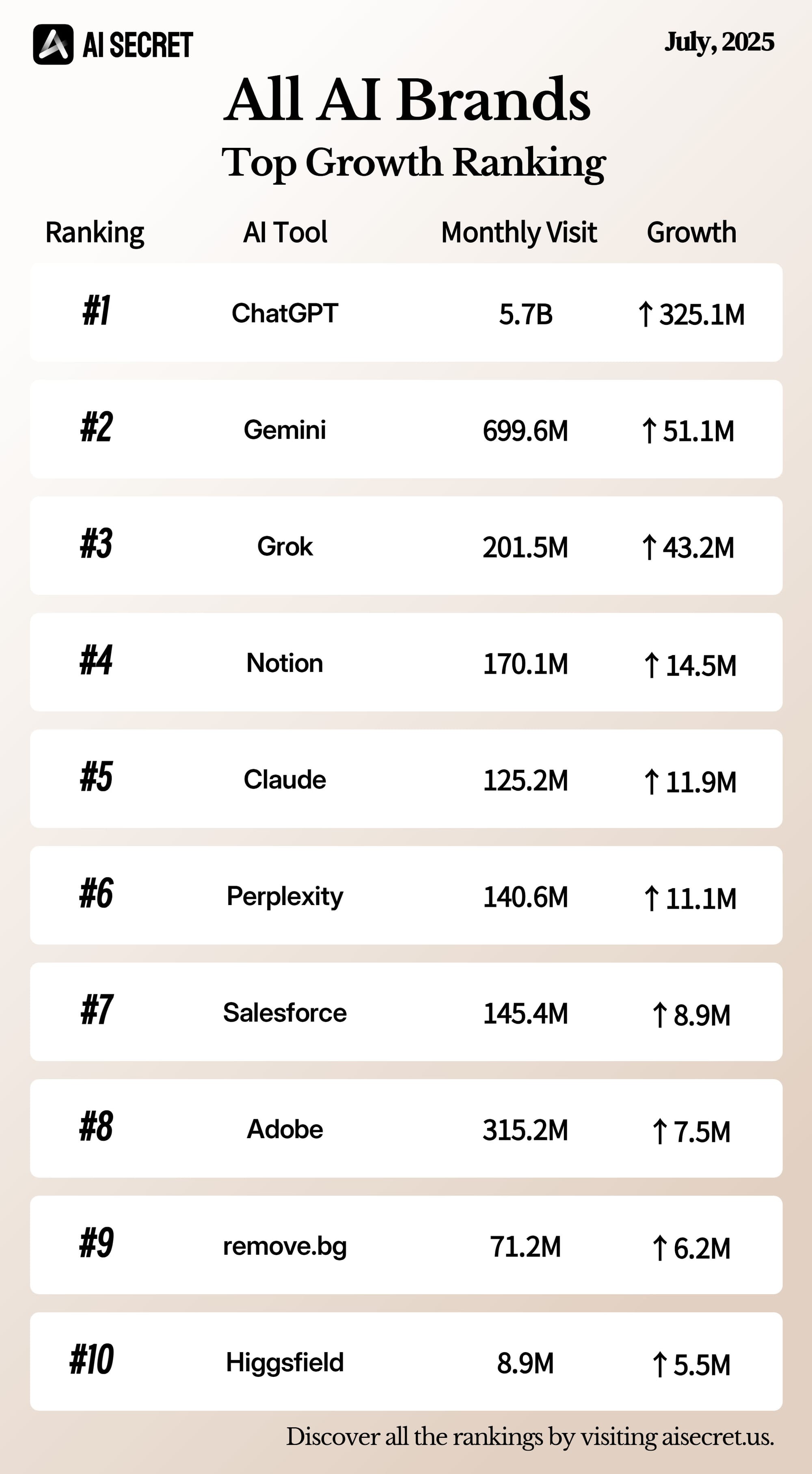
🧠 All AI Brands – Rebound at the Top, Diversification Below
In a reversal from last month’s leaderboard, ChatGPT surged +325.1M to hit 5.7B monthly visits, retaking the growth lead from Gemini. While Gemini still grew +51.1M (to 699.6M visits), the gap this month was decisive.
The rest of the top five saw Grok (+43.2M) leapfrog Claude, with Notion (+14.5M) and Claude (+11.9M) maintaining steady climbs. Perplexity (+11.1M) held strong in the search-oriented corner of the AI stack, while Salesforce (+8.9M) and Adobe (+7.5M) underscored the stickiness of enterprise and creative platforms.
Notion's rise is fueled by its seamless integration of AI into everyday workflows — from auto-summarizing notes to generating content with context. As teams increasingly seek all-in-one workspaces, Notion's AI-native features turn it from a productivity tool into an intelligent knowledge partner.
Notably, two vertical tools — remove.bg (+6.2M) and Higgsfield (+5.5M) — entered the overall top ten, a sign that specialized offerings are gaining enough traction to break into the all-AI conversation.
🛎️ Key takeaway: The top remains anchored by generalist platforms, but July marks a clear broadening — vertical utilities are finding their way into the big leagues.
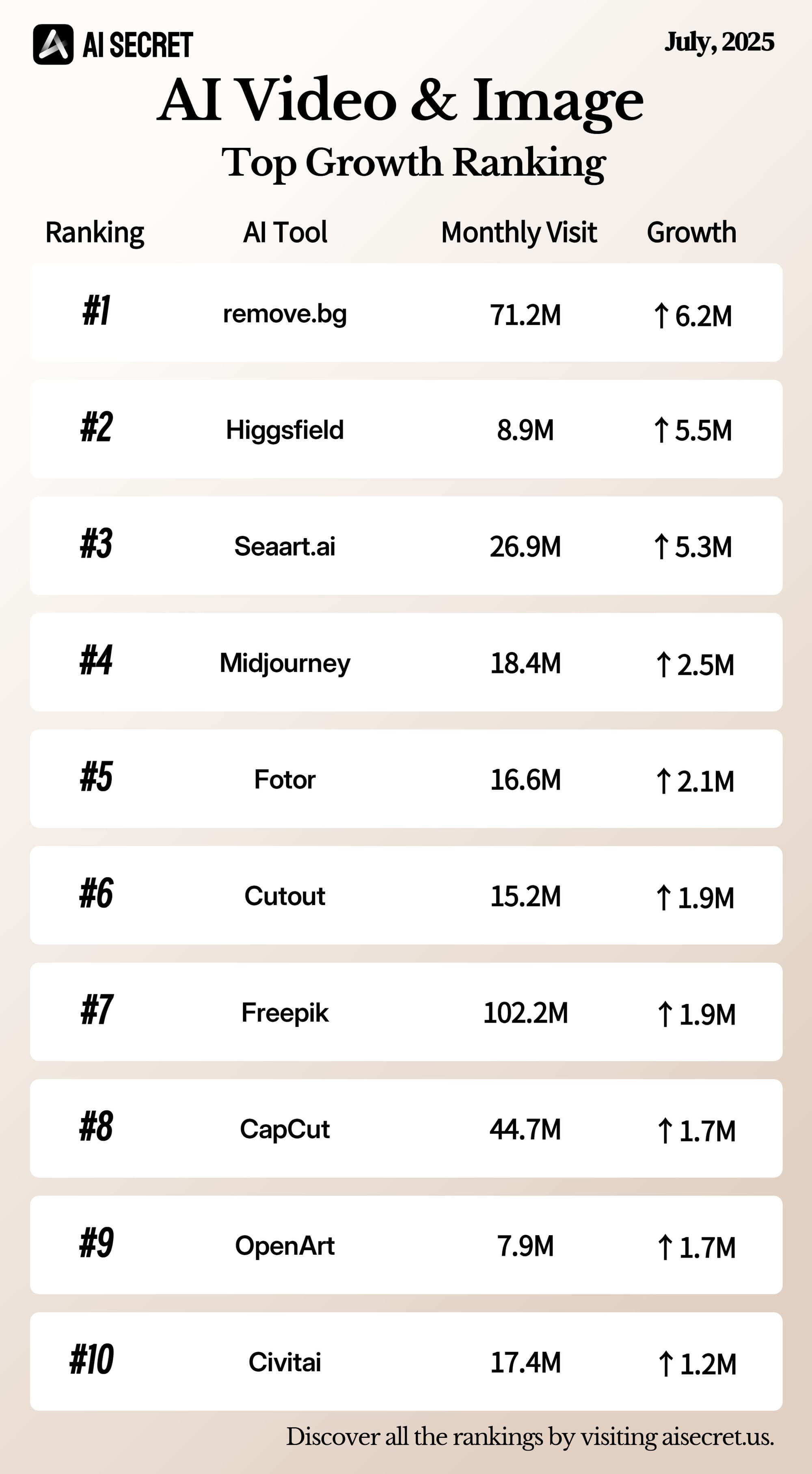
🎬 AI Video & Image – Micro-Utility Tools Quietly Win Big
Remove.bg claimed the #1 spot this month with +6.2M growth to 71.2M visits, leveraging its straightforward, high-demand image background removal capabilities. Close behind, Higgsfield (+5.5M) and Seaart.ai (+5.3M) proved that creative tools with a clear aesthetic edge still command attention.
Newcomers like Seaart.ai are riding the wave of AI-native creativity platforms, while Midjourney (+2.5M) continued its slow but steady rise, joined by Fotor (+2.1M) and Cutout (+1.9M) in serving the needs of creators, marketers, and e-commerce workflows. Freepik, CapCut, OpenArt, and Civitai rounded out a list that blended production utility with visual artistry.
Compared to June — when cinematic newcomer Veo 3 stole the show — July’s rankings reveal a pivot toward tools that deliver immediate, practical value alongside creative potential.
🛎️ Key takeaway: When it comes to visual AI, ease-of-use trumps power. Tools that solve one thing beautifully are growing faster than do-it-all platforms.
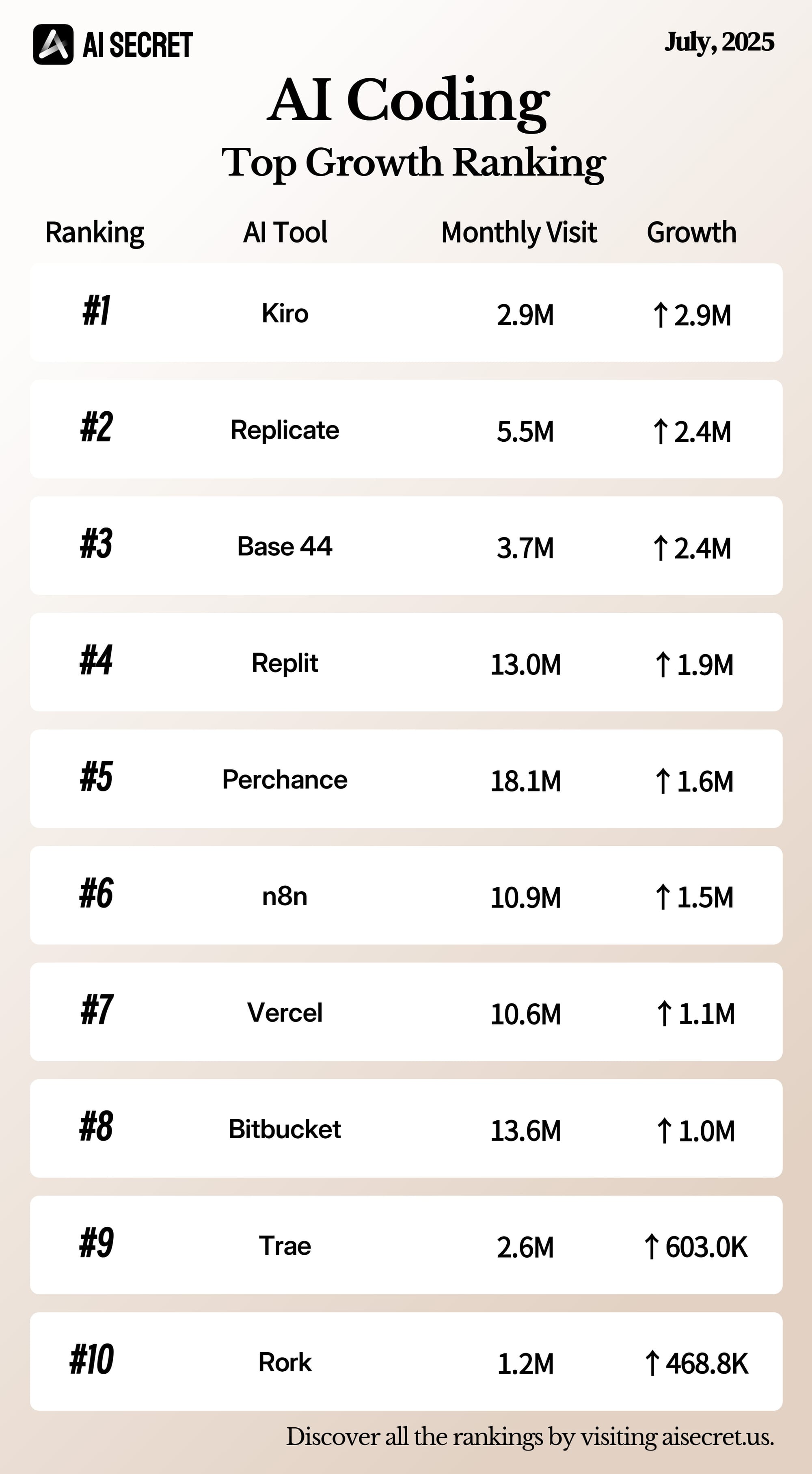
👨💻 AI Coding – New Builders Take the Lead
Kiro came out of nowhere to claim the #1 growth spot in coding tools with +2.9M new visits — a likely indicator of a product that fits the “copilot for X” archetype.
Replicate (+2.4M) and Base 44 (+2.4M) followed closely, showing strong demand for platforms that simplify model deployment and experimentation.
Replit (+1.9M) and Perchance (+1.6M) maintained momentum, with n8n (+1.5M), Vercel (+1.1M), and Bitbucket (+1.0M) reinforcing the backbone of the builder stack. Trae and Rork rounded out the top ten, catering to niche developer needs.
In June, Lovable ranked prominently in the AI Coding category, signaling strong early traction likely driven by buzz and initial user onboarding. However, by July, it dropped out of the top ranks — replaced by fast-rising tools like Kiro, which offer more focused, utility-driven features. This shift suggests that developer preferences are consolidating around tools with clear, task-specific value, while hype-driven products without sustained engagement are quickly overtaken.
🛎️ Key takeaway: The builder economy is fragmenting — new AI-native tools are claiming ground between traditional IDEs, scripting, and automation layers.
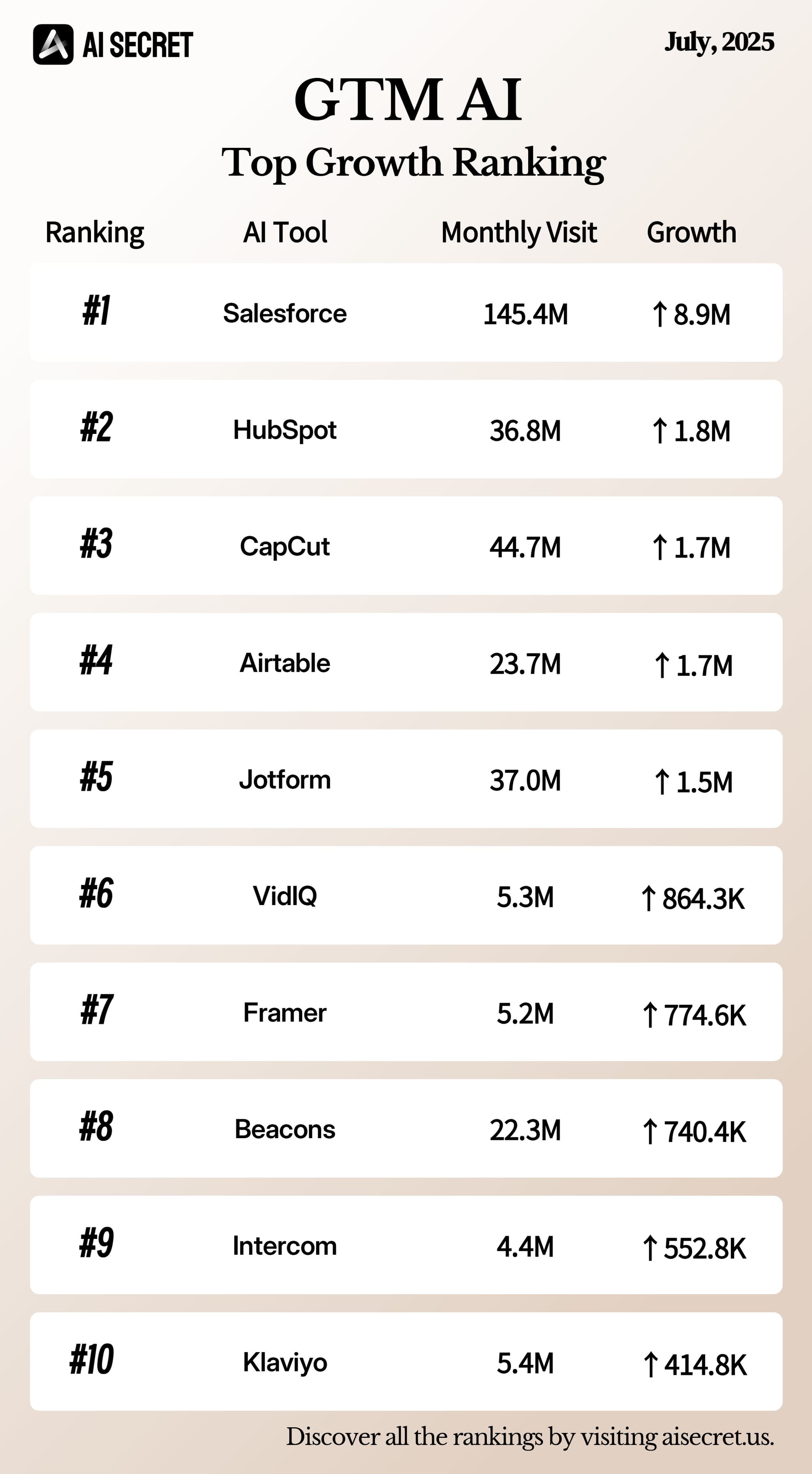
🚀 GTM AI – Salesforce Stays on Top, Niches Surge
Growth teams are quietly becoming AI-first. Salesforce (+8.9M) extended its dominance, serving as the AI-powered backbone for many GTM stacks. HubSpot (+1.8M) held its ground, while Airtable added +1.7M — all layering AI across content, CRM, and operations.
VidIQ (+864.3K) and Framer (+774.6K) show that creators and marketers are embracing AI for content strategy, landing pages, and distribution.
The presence of Beacons (+740.4K), Intercom (+552.8K), and Klaviyo (+414.8K) confirms a growing demand for AI in customer engagement and funnel automation.
Compared to June, GTM AI tools in July showed a shift from core CRM platforms to creator-focused and lightweight automation tools. While Salesforce maintained its lead, tools like VidIQ, Framer, and Beacons surged up the ranks — signaling growing adoption of AI among content-driven growth teams and indie marketers.
🛎️ Key takeaway: The AI go-to-market stack is taking shape — with every touchpoint from awareness to retention getting an intelligence upgrade.
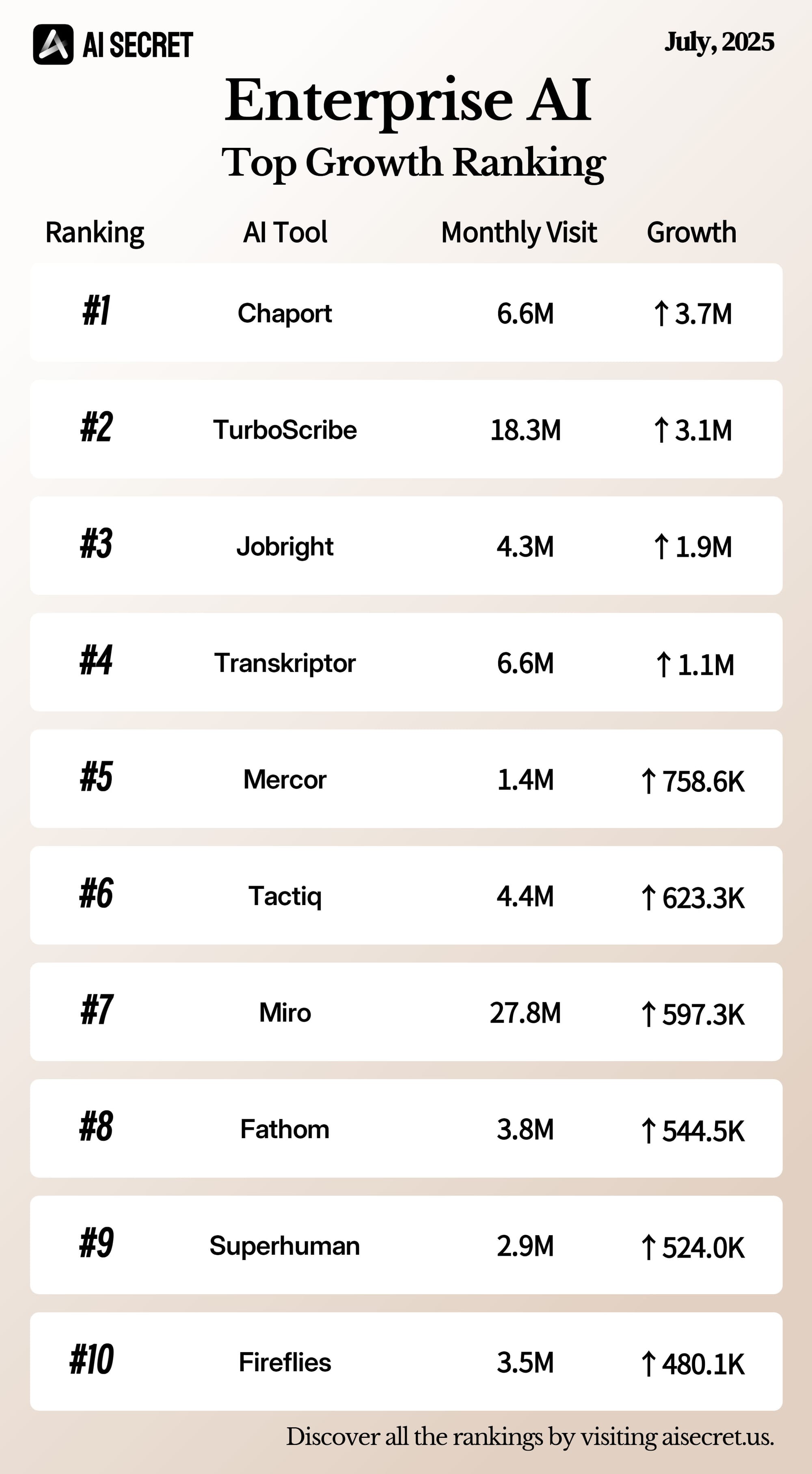
🏢 Enterprise AI – Specialized Copilots Win
In enterprise AI, Chaport (+3.7M) took the lead. TurboScribe (+3.1M) followed, capturing the transcription and meeting note market, while Jobright (+1.9M) carved a niche in recruitment intelligence.
Transkriptor (+1.1M) and Mercor (+758.6K) joined incumbents like Miro (+597.3K), as well as Tactiq, Fathom, Superhuman, and Fireflies — all focused on solving highly specific workflow challenges.
By July, the landscape shifted toward utility-first, operational tools — with Chaport, TurboScribe, and Transkriptor rising sharply. These tools address specific, high-frequency enterprise pain points like real-time support, transcription, and team documentation.
The contrast reflects a broader trend: enterprises are moving from flashy AI add-ons to embedded, ROI-driven automation that scales quietly in the background.
🛎️ Key takeaway: The next wave of enterprise AI is quiet. It’s not flashy — it’s embedded, useful, and often invisible.
🔚 Final Thoughts – The AI Growth Map Widens
July’s data underscores that while the giants are still towering over the field, the real action is happening at the edges:
What stood out across categories?
- Platform matters more than product: Tools with distribution and integration — like ChatGPT and CapCut — are growing faster than isolated products.
- Micro-utilities are macro-opportunities: The rise of remove.bg, TurboScribe, and Kiro proves there’s still massive upside in simple tools that own a single user need.
- AI Coding is fragmenting: Developers are shifting away from monolithic IDEs to lightweight, task-specific tools. The next wave of dev productivity is modular, autonomous, and deeply embedded in daily workflows.
- GTM AI is the sleeping giant: Marketing, sales, and onboarding are getting rebuilt with AI — not just automated, but orchestrated.
- Enterprise AI is maturing: The fastest-growing tools aren’t the ones chasing headlines — they’re helping teams work faster, document better, and sell smarter.
As the AI landscape matures, utility is outperforming novelty. July’s data reveals a clear shift: users are gravitating toward tools that solve real problems quickly, whether it's coding smarter, launching faster, or automating mundane workflows. The race isn’t just about intelligence anymore — it’s about adoption at scale.
TOGETHER WITH US
AI Secret Media Group is the world’s #1 AI & Tech Newsletter Group, boasting over 1 million readers from leading companies such as OpenAI, Google, Meta, and Microsoft. Our Newsletter Brands:
- AI: AI Secret
- Tech: Bay Area Letters
- Futuristic: Posthuman
We've helped promote over 500 Tech Brands. Will yours be the next?
Email our co-founder Mark directly at mark@aisecret.us if the button fails.
Related Stories
 Magna
 Magna
 Magna
 Magna

Welcome to our AI Secret Growth Map May 2025 Report
The AI ecosystem is evolving at a pace we’ve never seen before. In just a few years, artificial intelligence has gone from niche innovation to everyday infrastructure—powering everything from software engineering and enterprise productivity to creative workflows and autonomous agents.
At AI Secret, we’ve partnered with leading industry sources and analyzed real traffic data across millions of users to compile the May 2025 Growth Rankings. This report goes beyond hype and headlines—highlighting the tools actually winning attention, adoption, and user trust.
Whether you're an early-stage founder, product manager, investor, or simply fascinated by AI’s explosive momentum, this breakdown gives you a detailed look at where the market is heading—and who’s leading the charge.
Let’s dive into the momentum behind the machines. 👇

🧠 All AI Brands – The Broadest View of AI Growth
Our top-level ranking measures the overall growth in user visits across all AI product categories. Not surprisingly, ChatGPT remains in the #1 spot with a jaw-dropping +350.6M visit growth, bringing its total monthly visits to 5.5 billion. It’s not just an AI assistant—it’s a utility layer embedded into workflows around the globe.
Following closely is Google Gemini with +118.3M in growth, gaining ground quickly thanks to its widespread presence across Google’s ecosystem—Docs, Gmail, Android, and Search. It’s clear Gemini is becoming more than just a model—it’s a productivity enabler.
Perplexity, Claude, and Adobe also posted impressive gains, showing that search-oriented tools and creative platforms remain foundational to the AI stack.
🟢 Key Takeaway: Generalist LLMs still dominate traffic—but high-utility, focused tools are quickly carving out user mindshare.

👨💻 AI Coding – Developer Tools Take Off
Developers continue to be among the earliest and most enthusiastic adopters of AI. In May, Google AI Studio topped the coding charts with +7.9M growth, reflecting increased usage among enterprise and open-source teams alike.
Claude Code (a specialized code generation mode from Anthropic) saw +4.1M growth, proving the demand for aligned and safe coding copilots. Meanwhile, smaller but fast-growing tools like Kilo Code (+709.1K) and Rork (+400.8K) are seeing explosive growth from bootstrappers and indie hackers.
Cursor, Replit, and Windsurf all posted strong gains, reinforcing the trend of hybrid IDEs and code-enhancing assistants taking root in dev teams worldwide.
🟢 Key Takeaway: AI in code is no longer optional—it’s foundational. Tools that offer speed, structure, and reliability are winning the builder economy.

🤖 AI Agents – The Next Layer of Automation
AI agents are making waves, acting as autonomous task-runners and logic-based assistants. Manus holds the top spot this month, credited with building a flexible, multi-agent orchestration system that works out-of-the-box for startups and operations teams.
Genspark, a fast-growing newcomer, is gaining traction with its AI agent design experience. Skywork and Fellou bring focus to writing, research, and daily productivity tasks.
With AI agents now capable of managing inboxes, launching ad campaigns, and analyzing documents, adoption is spreading rapidly.
🟢 Key Takeaway: We're entering the “assistant economy.” The best AI agents aren’t just smart—they’re deeply useful. Agentic AI is a new field, and the top five products chosen in this survey represent community opinions and market interest. This provides a reliable overview of the current AI agent landscape.

🎬 AI Video – Visual Creation at Warp Speed
If there’s one category seeing skyrocketing innovation, it’s AI-powered video. HeyGen and Higgsfield both grew by +1.6M, with HeyGen focusing on avatar-driven explainers and Higgsfield on realism-enhanced shortform content.
Cutout.Pro continues to lead in practical utility—offering background removal, video enhancement, and editing tools for creators and ecommerce marketers.
Other breakout stars include Veo 3 (+660K), a newcomer known for cinematic generation quality, and LTX Studio, focused on storyboarding and animation. Even well-established tools like Opus Clip and Veed posted healthy gains, confirming video remains AI’s most viral medium.
🟢 Key Takeaway: The future of storytelling is AI-generated, and creators are hungry for tools that turn concepts into content—fast.

🖼️ AI Image – From Utility to Artistry
AI image tools continue to expand, merging utility and creativity. Adobe maintains dominance with +4.9M growth, driven by its native Firefly integration into Photoshop and Express. It’s proving that traditional creative platforms can win—when they move fast enough.
Remove.bg and Freepik cater to practical visual editing, while Midjourney, Tensor Art, and Pixelcut serve artists, designers, and ecom professionals looking for fast turnaround and stylistic flexibility.
Pippit AI, Flowith, and Photoroom represent the next generation: mobile-first, consumer-friendly, and ready for TikTok-era creation.
🟢 Key Takeaway: AI image tools are no longer novelty—they’re production-ready. And the competition between utility and aesthetics is heating up.

📈 GTM AI – Tools That Power Product Launches
In the go-to-market (GTM) category, AI is becoming a crucial launch lever. Replit tops the chart with +1.7M growth, showing developers are embracing code-driven product creation more than ever.
Jotform, with +1.6M growth, continues to lead for form automation, landing pages, and internal ops. Tools like Framer, Vmake AI, and Prezi bridge the gap between creative marketing and scalable launch systems.
Even specialized tools like Replient and Autoppt are showing traction—proving there’s appetite for automation across every part of the GTM stack.
🟢 Key Takeaway: AI is redefining the startup stack. Product launches are faster, leaner, and increasingly automated.

🏢 Enterprise AI – Quiet But Massive Momentum
Enterprise adoption tends to move slower—but once it starts, it scales hard. Adobe and Meta once again top the rankings, but newer platforms like Gamma (+2.5M) are becoming staples in internal documentation, team communication, and enterprise design.
Aura, Read AI, Suna, and Planner 5D help with everything from meeting summaries to spatial planning. Meanwhile, Airtable, Notta, and Abacus AI show strong growth in the automation and knowledge management space.
🟢 Key Takeaway: Enterprise AI isn’t flashy—but it’s sticky. Once integrated into workflows, these tools become indispensable.
🔚 Final Thoughts – AI’s Growth Curve Is Just Getting Started
Across every category—from dev tools and agents to enterprise apps and video creators—AI usage is accelerating, diversifying, and deepening. Major platforms continue to dominate in reach, but smaller tools with strong utility and fast iteration cycles are making serious moves. As AI becomes embedded into every workflow, the line between “tool” and “team member” is blurring.
What stands out most?
- AI video tools are exploding in popularity as creators seek faster, smarter workflows.
- AI agents and GTM platforms are reshaping how products launch, scale, and operate.
- Coding assistants are empowering developers at every level, while enterprise AI solutions are quietly streamlining workflows behind the scenes.
- Even hyper-niche tools are gaining traction—proof that demand isn't just broad, it's deep.
As the AI stack expands, one thing is clear: the future belongs to those building fast, adapting fast, and solving real problems.
TOGETHER WITH US
AI Secret Media Group is the world’s #1 AI & Tech Newsletter Group, boasting over 1 million readers from leading companies such as OpenAI, Google, Meta, and Microsoft. Our Newsletter Brands:
- AI: AI Secret
- Tech: Bay Area Letters
We've helped promote over 500 Tech Brands. Will yours be the next?
Email our co-founder Mark directly at mark@aisecret.us if the button fails.
Latest Daily Rundowns
Magna Ding Magna Ding
 Magna Ding

Latest AI Insights
Magna Magna
 Magna


End of Vending
Plus: Bank Bans Hugging Face, Rules Without Rulers
AI’s Free Lunch Is Over
Inside the global backlash against AI’s data hunger

AI Secret Growth Map: July 2025
Utility Wins-July’s Fastest-Growing AI Products Solve Real Problems
Trump Bets on Search AI
More Stories: Publishers Strike Back Against AI Giants
Perplexity Burned Rulebook
More Stories: Google’s Super Breakthrough, OpenAI's New Milestone
The K Prize: Popping the AI Coding Hype Bubble, One GitHub Issue at a Time
If you’ve been following the AI coding scene lately, you’d be forgiven for thinking we’re living in a golden age of machine programmers.

ChatGPT Wants to Be Your Shopping Assistant Now
If you thought ChatGPT was just a clever digital pen pal, brace yourself: it’s now eyeing your shopping cart. In a move that’s less

AI Browsing War
An AI Reached 2.2M Visitors in Weeks
AI Secret Growth Map: May 2025
Discover The Hidden Dynamics of the AI Industry