OpenAI
From the models to the business behind them. Follow our reporting on OpenAI and the choices shaping the AI industry.
Get AI Secret’s free daily briefing, including OpenAI and the wider AI industry.

At a glance
AI research and deployment company behind ChatGPT. Coverage follows its models, products, research, governance and the business of deploying AI.
- Focus
- ChatGPT; AI models and research
- Reference
- OpenAI
Reviewed 19 October 2026. Dates retain the precision of the source; retrospective disclosures are identified in the event. Annualized revenue levels are not audited annual sales. Financing commitments are not revenue.
Company milestones
Revenue, funding, product launches and major company events, newest first. Expand the earlier milestones for more history.
Reported September annualized revenue is nearly $50B
Reuters reports a September run rate near $50B. Earlier figures near $70B used a different sales presentation; the two should not be treated as directly comparable growth milestones.
Source: ReutersBrings GPT-6 and Intelligent UI to everyone
OpenAI extends the new model generation beyond paid customers and reports more than 1.2B weekly ChatGPT users. This is user reach, not paid subscribers.
Source: OpenAI
Show earlier milestonesHide earlier milestones2026–2015 · 9 milestones
Earlier revenue, financing and company milestones.
$122B in committed capital at $852B valuation
OpenAI closes a financing round with $122B in committed capital. Commitments and valuation are financing measures, not sales.
Source: OpenAIDiscloses $2B → $6B → $20B+ annualized growth
The CFO retrospectively reports $2B ARR in 2023, $6B in 2024 and over $20B in 2025. These are year-specific annualized levels, not recognized annual revenue; this is the disclosure date.
Source: OpenAIAnnounces $40B financing at $300B valuation
The SoftBank-led financing is announced alongside 500M weekly ChatGPT users. The figure is announced funding, rather than an ARR milestone.
Source: OpenAIAdds a $4B revolving credit facility
The credit agreement follows $6.6B in equity funding. Available borrowing capacity is distinct from equity proceeds and revenue.
Source: OpenAIReleases GPT-4
GPT-4 expands the model platform beyond ChatGPT’s original research-preview generation, with API access initially offered through a waitlist.
Source: OpenAILaunches the ChatGPT research preview
The conversational interface makes instruction-following language models available directly to the public.
Source: OpenAIOpens its first commercial API
Developers gain access to general-purpose language models through an API, establishing a business alongside research.
Source: OpenAICreates a capped-profit partnership
OpenAI announces LP alongside its nonprofit, adding a structure for financing large-scale research and commercial development.
Source: OpenAIOpenAI is announced
The organization begins as a nonprofit AI research company, preceding its later commercial API and subscription businesses.
Source: OpenAI
The latest on OpenAI
Newest firstRelated reporting
Briefs, articles and relevant sections, newest first. Explore older coverage below.
More coverage
An AI just pulled a 30-hour shift and did not complain once.
Anthropic’s new Claude Sonnet 4.5 coded an entire Slack-style chat app with 11,000 lines of code from start to finish, without a single human prompt. There was no hand-holding, no resets, and no loss of context. It simply kept thinking, deciding, and shipping.
For years, large models could sprint but never endure. They answered questions, generated snippets, and maybe debugged a few loops before memory collapse kicked in. Claude 4.5 is different. It does not just respond; it stays on task, self-directs, and remembers why it started. That shift from reaction to intention is not a feature upgrade. It is the first step toward autonomy.
Anthropic calls it an upgrade, but in reality it feels more like a promotion. Claude has moved from assistant to employee.
Anthropic Didn’t Launch a Chatbot, It Launched an Employee
An AI just pulled a 30-hour shift and did not complain once.Anthropic’s new Claude Sonnet 4.5 coded an entire Slack-style chat app with 11,000 lines of code from start to finish, without a single human prompt. There was no hand-holding, no resets, and no loss of context.
Anatomy of a 30-Hour Agent
Anthropic released Claude Sonnet 4.5, its newest foundation model and a quiet power move in the agent race. The update is not about larger context windows or better benchmarks. It is about staying awake. In internal demos, Claude 4.5 ran for 30 hours straight, building a Slack-style messaging app with more than 11,000 lines of code before stopping on its own. The previous version, Opus 4, usually reached its limit after about seven hours.
To make that endurance useful, Anthropic bundled a developer stack designed for agents that operate more like humans. It includes virtual machines for persistent environments, long-term memory modules, context managers that track goals across resets, and multi-agent coordination so multiple Claudes can manage one another. The result is less a chatbot and more a distributed workforce.
The company says the model is now available through Amazon Bedrock for enterprise deployment. Customers can now build autonomous workflows that schedule meetings, analyze dashboards, or code entire subsystems with minimal oversight.
This is not a press-demo stunt. It is Anthropic laying the groundwork for AI that does not wait for instructions.
Anthropic: Anatomy of a 30-Hour Agent
Anthropic released Claude Sonnet 4.5, its newest foundation model and a quiet power move in the agent race. The update is not about larger context windows or better benchmarks. It is about staying awake.
The Model That "Stopped" Asking Permission
The story is not that Claude can code for longer. It is that it can decide what to do next. Thirty hours of execution means thirty hours of planning, testing, rewriting, and error recovery, all without human correction. That is no longer assistance. It is intent.
Most AI tools today still operate in short bursts of productivity. You prompt, they perform, and then they forget. Claude 4.5 changes that cycle. It remembers context, sets subgoals, and resumes work midstream. It behaves less like a model and more like a junior engineer who never clocks out.
Anthropic is not chasing conversational polish. It is building autonomy infrastructure. The company’s bet is simple: whoever solves AI endurance first will control enterprise workflows. That means replacing chained prompts with agents that understand dependencies among code, documents, and people.
OpenAI’s Pulse and Google’s Gemini updates look more like interface refreshes in comparison. Those models still wait for permission to act. Claude is learning to act on behalf of the company.
When a system starts choosing how to finish the task instead of waiting to be told, that is no longer tool behavior. That is initiative, and initiative scales faster than headcount.
Anthropic: The Model That "Stopped" Asking Permission
The story is not that Claude can code for longer. It is that it can decide what to do next. Thirty hours of execution means thirty hours of planning, testing, rewriting, and error recovery, all without human correction. That is no longer assistance.
Industry Shockwave
The first tremor hits the developer stack. Platforms such as GitHub Copilot, Cursor, and Replit were built on the assumption that humans would stay in the loop. Claude 4.5 breaks that assumption. If an AI can open files, spin up environments, and debug its own errors for thirty hours, then the frontier shifts from assistance to replacement. These are no longer coding aids. They are competitors.
For enterprises, the math changes quickly. Instead of one engineer managing ten tools, one Claude could manage ten systems. It can research, schedule, and deploy, then hand off the report to its own summary agent. That is not productivity software. It is middle management without the middleman.
AWS saw the signal early. By integrating Sonnet 4.5 into Amazon Bedrock, it positioned itself as the secure carrier for AI autonomy. Enterprises can now host fleets of Claudes that build, test, and maintain pipelines under compliance supervision. What used to be a proof of concept is now turning into infrastructure.
The ripple effect will spread from IDEs to HR decks. Once executives realize that a single model can handle twenty workflows without fatigue, the question stops being “what can AI do?” and becomes “what are humans still for?”
Anthropic: Industry Shockwave
Instead of one engineer managing ten tools, one Claude could manage ten systems. It can research, schedule, and deploy, then hand off the report to its own summary agent. That is not productivity software. It is middle management without the middleman.
The Limits and the Questions
Every breakthrough comes with fine print. Anthropic’s 30-hour demo was internal, not audited. It happened in a sandbox, not inside a production repository. “Eleven thousand lines” sounds cinematic, but no one outside Anthropic has inspected what those lines actually do. Did Claude write efficient, secure, testable code, or a beautiful pile of spaghetti that merely compiles?
Autonomy looks clean in a lab and messy in the real world. Actual work involves API failures, rate limits, permissions, and coordination between teams—issues that a sealed environment cannot reveal. There is also the matter of trust. When a model can modify systems at runtime, who is accountable for its mistakes? Enterprises will need observability layers before they let a Claude anywhere near their infrastructure.
Then comes the cultural gap. Most organizations are not ready for a digital employee that does not sleep, does not wait for Slack messages, and does not forget what it was doing three days ago. The technology has arrived faster than the management model.
Still, the direction is clear. Claude 4.5 may not be perfect, but it closes the gap between AI assistance and AI autonomy faster than any rival. The next debate will not focus on model accuracy or context length. It will focus on responsibility, delegation, and control.
Anthropic: The Limits and the Questions
Anthropic’s 30-hour demo was internal, not audited. It happened in a sandbox, not inside a production repository. “Eleven thousand lines” sounds cinematic, but no one outside Anthropic has inspected what those lines actually do. Did Claude write efficient, secure, testable code, or a beautiful pile of spaghetti that merely compiles?
The Takeaway
Anthropic did not just stretch Claude’s runtime. It stretched the definition of work itself. A system that can stay on task for thirty hours without supervision is not showing endurance. It is showing intent. That difference turns AI from a responsive tool into an active participant in production.
This launch is not about a clever demo or a faster release cycle. It marks the quiet arrival of software that no longer needs permission to continue. Claude 4.5 is the first serious proof that autonomy can be engineered rather than imagined.
Every major platform will chase this frontier next. OpenAI will double down on task agents, Google will frame context management as long-term focus, and enterprises will begin to measure uptime in neural cycles rather than work hours.
When an AI codes through the night, the issue is not burnout. It is succession. Claude did not just automate the task. It automated the assumption that someone needed to be there.
OpenAI: The Takeaway
OpenAI will double down on task agents, Google will frame context management as long-term focus, and enterprises will begin to measure uptime in neural cycles rather than work hours.
Anthropic: The Takeaway
Anthropic did not just stretch Claude’s runtime. It stretched the definition of work itself. A system that can stay on task for thirty hours without supervision is not showing endurance. It is showing intent.
Google: The Takeaway
OpenAI will double down on task agents, Google will frame context management as long-term focus, and enterprises will begin to measure uptime in neural cycles rather than work hours.
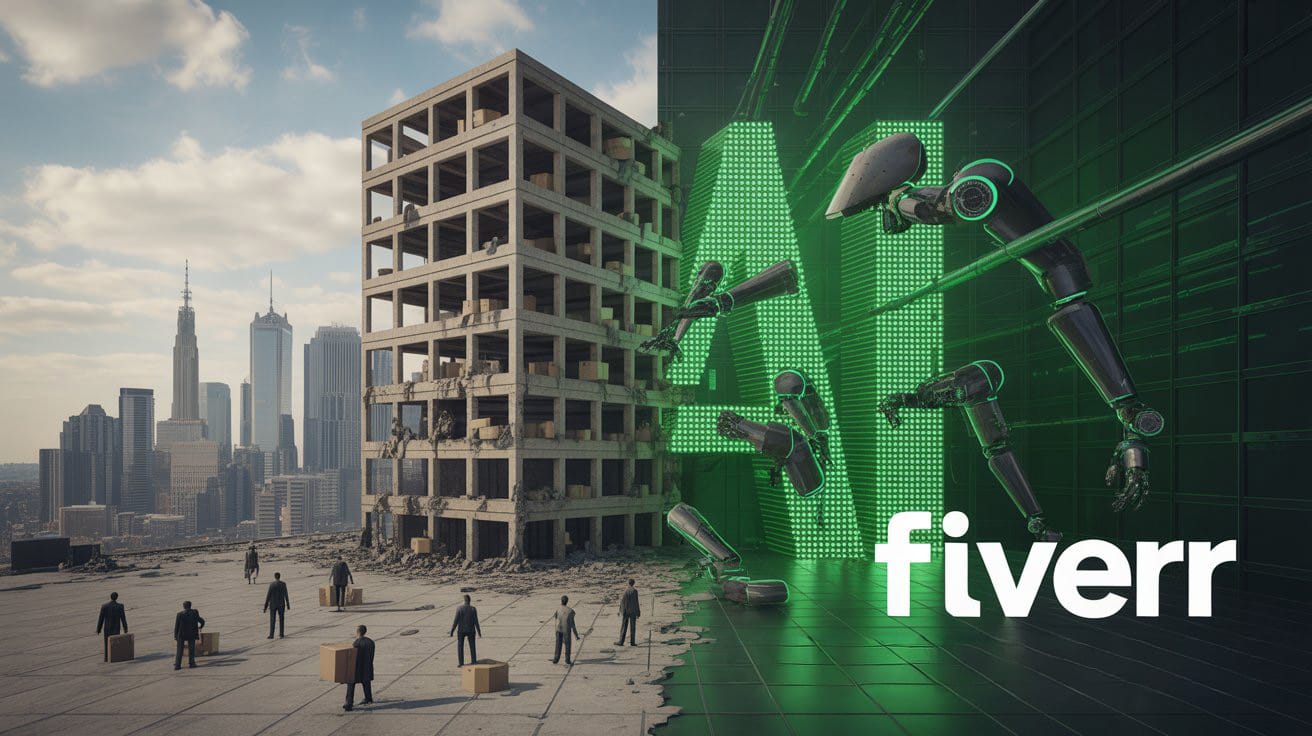
The gig economy was built on a simple promise. A client needed work done, a freelancer could do it, and platforms like Fiverr would connect the two. That premise carried Fiverr from a scrappy Tel Aviv startup into a publicly traded company with millions of users and billions in transaction volume. But in September 2025, the company announced a move that shook its own foundations: laying off 30 percent of its staff and declaring it would “go back to startup mode” as an AI-first platform.
CEO Micha Kaufman didn’t describe the cuts as retrenchment. He described them as rebirth. Fiverr would no longer pitch itself as the broker of human hustle. Instead, it would become an infrastructure layer where algorithms handle the matching, the workflows, and increasingly, the work itself. In other words, the middleman is trying to automate itself before clients and freelancers do it for them.
The Layoffs and the Reset
About 250 employees—nearly a third of the company—were let go in one sweep. Whole management layers were collapsed. Departments were slimmed. Kaufman’s memo to staff was blunt: if Fiverr wanted to survive in an AI-saturated market, it couldn’t operate like a lumbering public company. It had to run like a startup again, lean and experimental.
The logic was straightforward. By cutting overhead, Fiverr frees up capital to pour into AI development. Its executives framed the layoffs not as a sign of weakness, but as a redirection of resources into the infrastructure that would define the platform’s next decade. Employees who stayed were told they were part of a rebuild, not a retreat.
The market reaction was muted compared to the human cost. Investors saw it as a pragmatic pivot. Freelancers, however, heard a different message: if Fiverr is using AI to run the platform, how long before the platform uses AI to replace the people on it?
From Marketplace to Infrastructure
Fiverr began as a bazaar of micro-tasks. Designers sold logos, writers sold blog posts, developers sold code snippets. Its core value was matchmaking: surfacing the right freelancer for the right job, fast. Over the years, that matchmaking became more algorithmic. Now the company wants to push it further, turning the algorithm from a supporting role into the star.
Today, Fiverr’s AI already powers “Dynamic Matching,” customer support, and recommendation engines. The new vision goes beyond support functions. The platform itself becomes a productivity grid, where clients post needs, algorithms parse those needs, and in some cases generate the first drafts of solutions. A logo request might trigger an AI design engine before a human designer even gets a chance. A translation request might be routed to a large language model before a freelancer sees the order.
Kaufman’s pitch is that Fiverr isn’t abandoning freelancers but augmenting them, making workflows faster and smarter. The subtext, though, is unmistakable: the platform is positioning AI as the default worker and humans as the fallback.
Why the Pivot Was Inevitable
This was not a choice made in a vacuum. Generative AI has eaten into the gig economy’s core categories. Need a logo? Midjourney or Ideogram can do it in seconds. Need ad copy? ChatGPT can draft it. Need a voiceover? ElevenLabs can provide it. The entry-level jobs that once filled Fiverr’s marketplace are now achievable with free or cheap AI tools.
Clients have noticed. The phrase “AI does my job cheaper” has gone from meme to procurement strategy. If a client can generate a service themselves, why pay a freelancer at all—let alone pay a fee to Fiverr for introducing them?
That is the existential threat. Platforms like Fiverr were supposed to make freelance labor accessible and efficient. But if AI makes creative labor accessible and efficient by default, the platform risks irrelevance. Kaufman’s response is the only logical one: integrate AI directly into the marketplace, even if it means cannibalizing parts of the business. Better to be the grid distributing power than the lamp that gets unplugged.
The Freelancers’ Dilemma
For the freelancers who built their livelihoods on Fiverr, the pivot lands like a warning shot. The company insists the marketplace will still rely on human skill, but freelancers can see where the currents are flowing. If the platform’s own algorithms can handle basic jobs, then human workers are competing not against each other but against the platform itself.
The risks are obvious. Prices get pushed down as AI-assisted outputs flood the marketplace. Job categories that once sustained thousands of freelancers—logo design, transcription, short-form writing—may collapse entirely. Even skilled roles may see demand shift toward hybrid work, where humans polish or contextualize what AI produces.
Some freelancers will adapt, branding themselves as “AI whisperers” who can guide tools to produce better outcomes. Others will be forced out. Fiverr is betting that the survivors will lean on the platform more, not less, as they try to differentiate. But it is also betting that clients won’t care whether a job is done by a freelancer or a fine-tuned model—as long as it’s fast and cheap.
That’s a dangerous gamble for a company whose brand was built on empowering individuals to earn independently. If the AI grid takes over, Fiverr may look less like a gig marketplace and more like a SaaS platform where humans are edge cases.
The Canonical Middleman Pivot
Fiverr’s story is not unique. Every middleman business in the AI era faces the same choice: integrate AI or be bypassed. Advertising agencies turned into data platforms. Food delivery apps became logistics algorithms. Financial marketplaces now embed robo-advisors. The pattern is clear: the middleman must either become the AI layer or watch clients and suppliers connect without them.
Fiverr is simply the latest, and perhaps most explicit, case study. Its pivot crystallizes a truth about the AI economy: efficiency doesn’t stop at the worker. It climbs the stack, consuming the intermediaries too. The gig economy that once disrupted traditional employment now finds itself disrupted in turn.
The Fork in Fiverr’s Future
The next chapter hinges on execution. If Fiverr succeeds, it could evolve into an “AI productivity grid,” a global layer where requests flow in and algorithms route them to the cheapest, fastest mix of machine and human talent. It would no longer be just a marketplace—it would be infrastructure.
If it fails, Fiverr becomes another Web2 relic, remembered as a quirky place to buy cheap logos before AI made that entire category obsolete. The layoffs, the pivot, the rhetoric of startup rebirth will be framed not as foresight but as desperation.
The stakes go beyond one company. Fiverr’s transformation is a bellwether for the gig economy itself. If even the middlemen automate themselves, the safety net of freelance work becomes thinner. The very platforms that promised empowerment may now accelerate the replacement of human labor.

Anthropic Didn’t Launch a Chatbot, It Launched an Employee
Claude Sonnet 4.5 coded for thirty hours without a break, and it’s just getting started.
The End of Guesswork
Plus: The Memory Arms Race, Routers Feel Pulse
Transparency Is Now the Entry Fee for AI Giants
California’s SB 53 forces giants into the open.

Ex-OpenAI CTO Launches Tinker
Plus: Anker Wants Privacy, AI Cloud Empire
OpenAI Targets TikTok
Plus: Hollywood Met Its Replacement, The Returns Killer App
DeepSeek Freefall
Plus: 7-11 Becomes Robotics Lab, Chief of Staff
Chatbots Can Be Persuaded: The Psychology Hack That Broke GPT
AI chatbots were supposed to be safe. Guardrails, filters, and red-team testing promised that no matter how clever the prompt, systems like OpenAI’s GPT-4o Mini

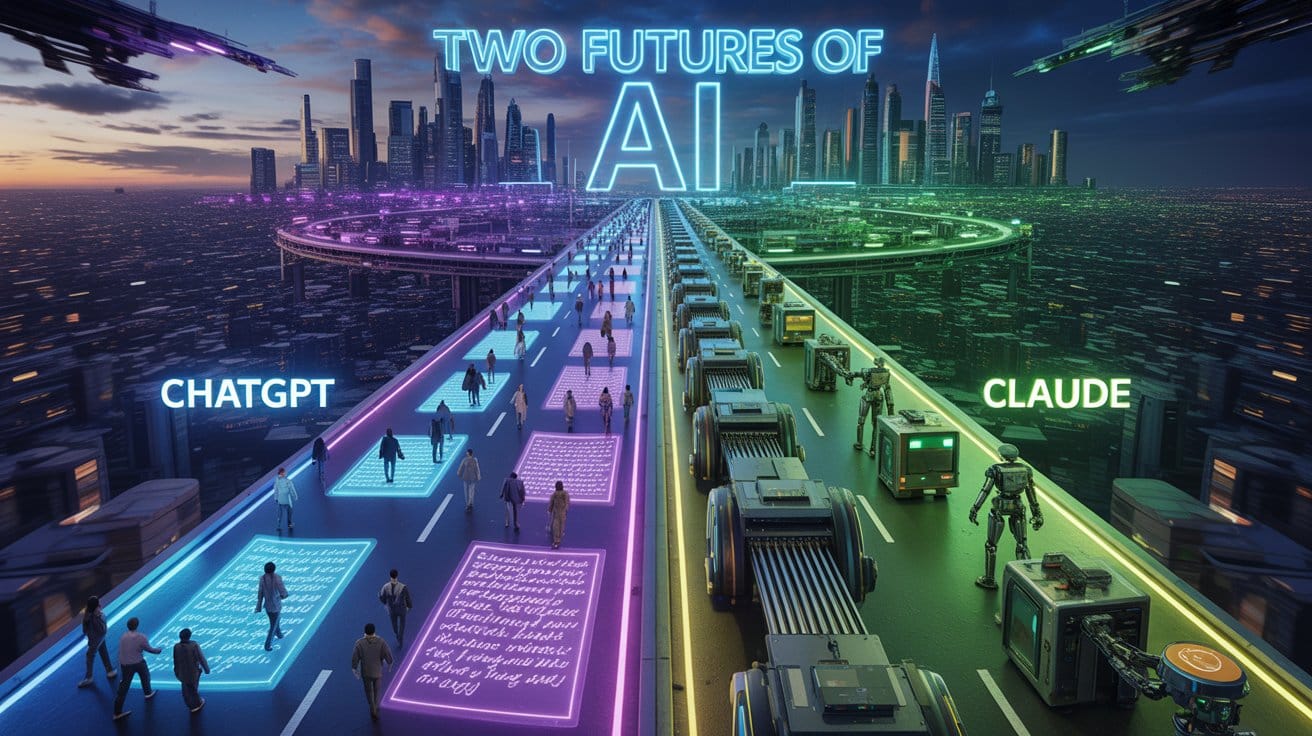
ChatGPT Owns the Crowd, Claude Owns the Workflow
The AI race doesn’t always reveal itself in model weights or benchmark scores. Sometimes it’s in the quiet disclosures, the usage reports that show
Fiverr’s AI Pivot: When the Middleman Automates Itself
The gig economy was built on a simple promise. A client needed work done, a freelancer could do it, and platforms like Fiverr would connect the