Inside Gemini’s Viral June Surge
According to the AI Secret Top Growth Ranking Report – June 2025, Gemini—Google’s flagship AI platform—pulled off what can only be described as the digital equivalent of a rockstar stadium
Read the story
Reporting and context on Google, with a closer look at the decisions and developments that matter.
Get AI Secret’s free daily briefing, including Google and the wider AI industry.

Google is part of Alphabet. This topic follows its AI research, Gemini models, Google DeepMind, cloud infrastructure and consumer products.
Reviewed 19 October 2026. Dates retain the precision of the source; retrospective disclosures are identified in the event. Google Cloud and Alphabet revenue are separate reporting scopes; cloud revenue is not synonymous with AI ARR.
Revenue, funding, product launches and major company events, newest first. Expand the earlier milestones for more history.
Google expands access through developer and enterprise APIs, AI Studio, Gemini and Search subscriptions following its initial restricted rollout.
Source: GoogleAlphabet’s second-quarter release reports accelerating cloud demand for AI infrastructure and solutions. Alphabet’s total quarterly revenue is $119.8B; it is not all AI revenue.
Source: Alphabet earnings releaseEarlier revenue, financing and company milestones.
Q2 Google Cloud revenue increases 32%, with growth across core infrastructure, AI products and Workspace.
Source: AlphabetGoogle unveils a multimodal model family, connecting its research programs to consumer and developer products.
Source: GoogleGoogle combines DeepMind and the Brain team to consolidate its frontier AI research effort.
Source: GoogleAttention Is All You Need introduces the architecture underlying many later language models, including systems beyond Google.
Source: Google research paperCloud TPU infrastructure extends Google’s custom machine-learning hardware to outside developers and organizations.
Source: GoogleGoogle’s founders outline a reorganization separating Google’s core operating business from other long-term ventures.
Source: GoogleThe search company later becomes the largest operating business within Alphabet.
Source: Alphabet annual reportBriefs, articles and relevant sections, newest first. Explore older coverage below.
More coverage
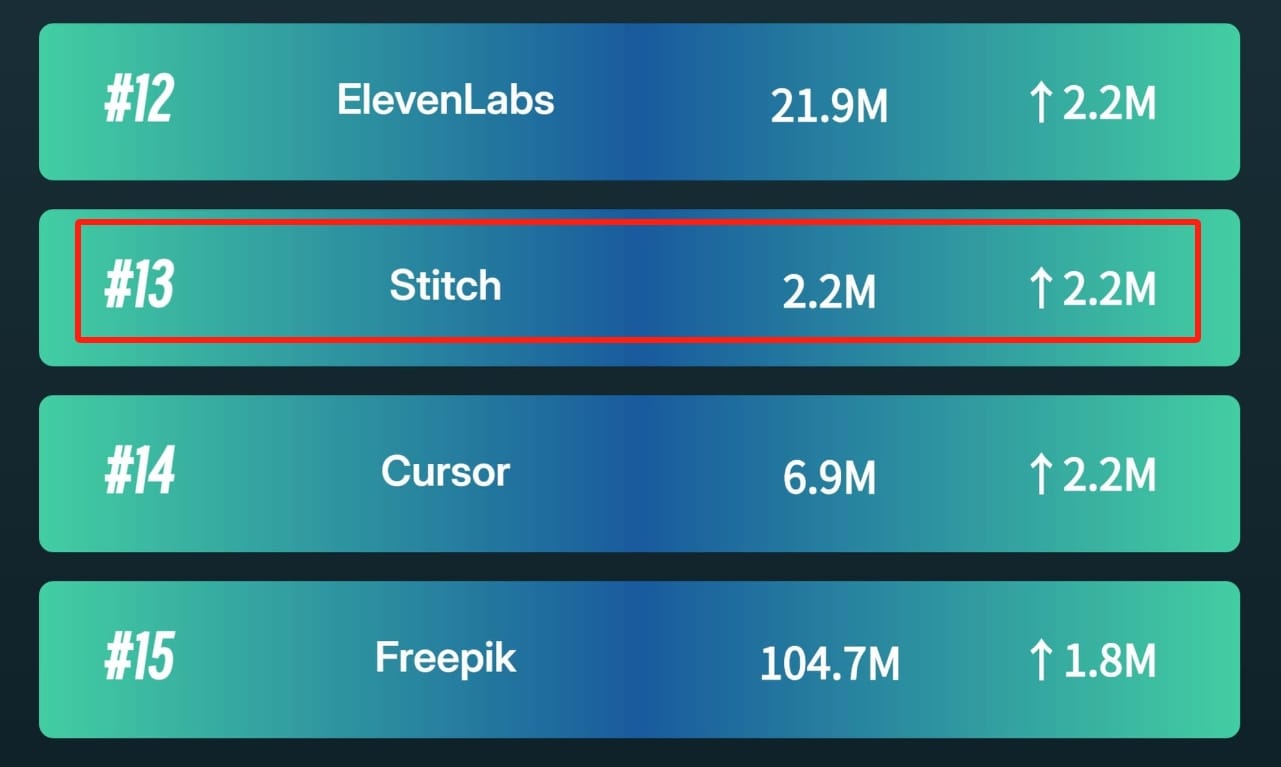
According to the insights outlined in the AI Secret Top Growth Ranking Report - May 2025, Stitch AI has achieved impressive growth. Stitch by Google, a generative AI-powered UI design tool, achieved remarkable growth shortly after its launch at Google I/O 2025. Within weeks, Stitch attracted 2.2 million new visitors in May 2025, solidifying its position as a disruptive innovation in the design and development space. Let's dissect the cold-start strategies, product strengths, growth channels, and retention mechanics that fueled Stitch’s rapid adoption.
Launching a new product, especially one as ambitious as Stitch, requires overcoming the "cold-start problem," where a lack of initial users can hinder growth. Stitch’s success stemmed from a combination of strategic positioning, product readiness, and leveraging Google’s ecosystem.
Stitch began as an experimental project under Google Labs, a platform known for fostering innovative tools. This positioning allowed Stitch to benefit from Google’s credibility while maintaining the agility of a startup-like team. The small founding team of designers and engineers ensured a focused approach to building a minimum viable product (MVP) that addressed specific pain points in UI/UX design.
To reduce barriers to entry, Stitch was made available for free during its early preview phase. This strategy encouraged adoption among UI/UX designers, developers, and solo founders who were curious about AI-powered design tools but hesitant to invest in unproven solutions. Free access also created a low-risk environment for users to experiment with the tool and provide valuable feedback.
Stitch leveraged Google’s Gemini 2.5 Pro, a multimodal AI model, to deliver advanced generative capabilities. This integration enabled Stitch to generate complete UI designs from text prompts, wireframes, or screenshots, offering instant value to users. The MVP focused on core features like natural language UI generation, live code export, and Figma integration, ensuring that the product was both functional and impactful from day one.
Stitch began as an experimental project under Google Labs, a platform known for fostering innovative tools. This positioning allowed Stitch to benefit from Google’s credibility while maintaining the agility of a startup-like team. The small founding team of designers and engineers ensured a focused approach to building a minimum viable product (MVP) that addressed specific pain points in UI/UX design.
Stitch’s rapid growth was underpinned by its ability to solve real problems for its target audience. Its product strengths not only differentiated it from competitors but also ensured that users experienced tangible benefits.
Stitch’s standout feature was its ability to generate complete UI designs from natural language prompts or visual inputs like screenshots and wireframes. For example, users could describe a design—such as “a dashboard for an education platform focused on AI and automation”—and Stitch would produce a responsive layout within seconds. This feature significantly reduced the time and effort required to create prototypes, making it a game-changer for designers and developers.
Stitch’s integration with popular design tools like Figma and its ability to export HTML/CSS code directly made it highly versatile. Users could refine their designs in Figma or use the exported code for development, bridging the gap between design and implementation. This interoperability ensured that Stitch fit seamlessly into existing workflows.
Stitch allowed users to customize their designs in real time through an interactive chat interface. Features like theme selection, color adjustments, and font modifications enabled users to tailor their designs to specific needs. This level of customization enhanced user satisfaction and reinforced Stitch’s value proposition.
Stitch’s explosive growth was driven by strategic use of launch platforms, community engagement, and media coverage. These growth channels amplified its reach and credibility.
Google I/O 2025 served as the perfect platform to unveil Stitch. The event attracted a global audience of developers, designers, and tech enthusiasts, providing Stitch with unparalleled visibility. The announcement at Google I/O positioned Stitch as a cutting-edge tool backed by one of the world’s most trusted tech companies.
Stitch’s team and early adopters created tutorials and demos on platforms like YouTube, Twitter, and LinkedIn. These resources showcased Stitch’s capabilities and provided practical guidance, encouraging more users to try the tool. Community-driven content also fostered a sense of belonging among users, turning them into advocates for the product.
Stitch garnered extensive media coverage from outlets like TechCrunch, Medium, and design-focused blogs. Articles highlighted its innovative features and potential to disrupt the design industry, further boosting its credibility. This coverage not only attracted new users but also positioned Stitch as a thought leader in the AI and design space.
Stitch’s ability to convert users into loyal advocates was key to sustaining its growth. Its retention strategies focused on delivering value, fostering engagement, and iterating based on feedback.
By offering free access to a tool that generated real, usable designs, Stitch ensured that users experienced immediate value. This approach encouraged users to explore the tool further and share their experiences with others, creating a viral growth loop.
Stitch actively solicited feedback from its early users and incorporated their suggestions into rapid feature updates. This iterative approach not only improved the product but also demonstrated that Stitch valued its users’ input, fostering trust and loyalty.
Stitch’s integration with Figma and its ability to export designs in multiple formats made it easy for users to share their work with colleagues and clients. This shareability increased Stitch’s visibility and encouraged adoption within teams and organizations.
Stitch’s journey offers valuable lessons for teams of early-stage AI or SaaS products:
Teams of early-stage AI or SaaS products can draw inspiration from Stitch’s success to achieve high-velocity adoption and long-term growth.

Welcome to our AI Secret Growth Map May 2025 Report
The AI ecosystem is evolving at a pace we’ve never seen before. In just a few years, artificial intelligence has gone from niche innovation to everyday infrastructure—powering everything from software engineering and enterprise productivity to creative workflows and autonomous agents.
At AI Secret, we’ve partnered with leading industry sources and analyzed real traffic data across millions of users to compile the May 2025 Growth Rankings. This report goes beyond hype and headlines—highlighting the tools actually winning attention, adoption, and user trust.
Whether you're an early-stage founder, product manager, investor, or simply fascinated by AI’s explosive momentum, this breakdown gives you a detailed look at where the market is heading—and who’s leading the charge.
Let’s dive into the momentum behind the machines. 👇
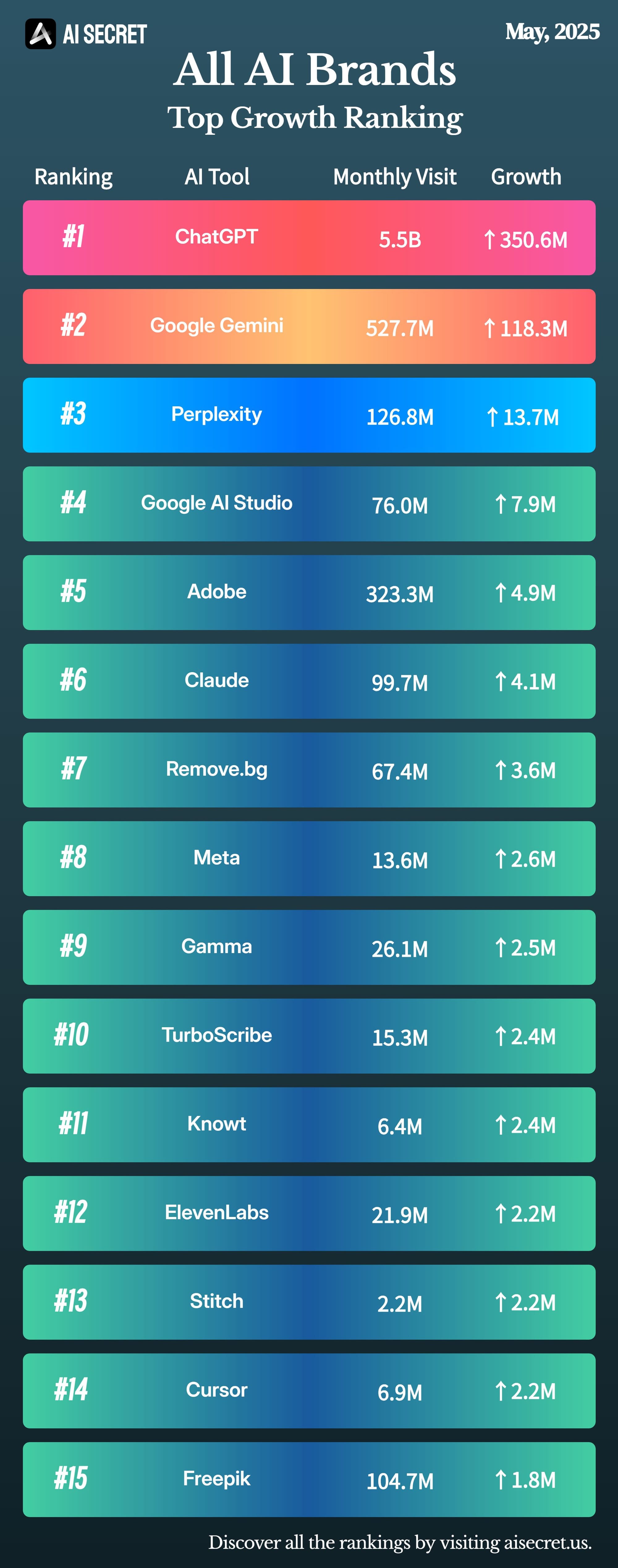
Our top-level ranking measures the overall growth in user visits across all AI product categories. Not surprisingly, ChatGPT remains in the #1 spot with a jaw-dropping +350.6M visit growth, bringing its total monthly visits to 5.5 billion. It’s not just an AI assistant—it’s a utility layer embedded into workflows around the globe.
Following closely is Google Gemini with +118.3M in growth, gaining ground quickly thanks to its widespread presence across Google’s ecosystem—Docs, Gmail, Android, and Search. It’s clear Gemini is becoming more than just a model—it’s a productivity enabler.
Perplexity, Claude, and Adobe also posted impressive gains, showing that search-oriented tools and creative platforms remain foundational to the AI stack.
🟢 Key Takeaway: Generalist LLMs still dominate traffic—but high-utility, focused tools are quickly carving out user mindshare.
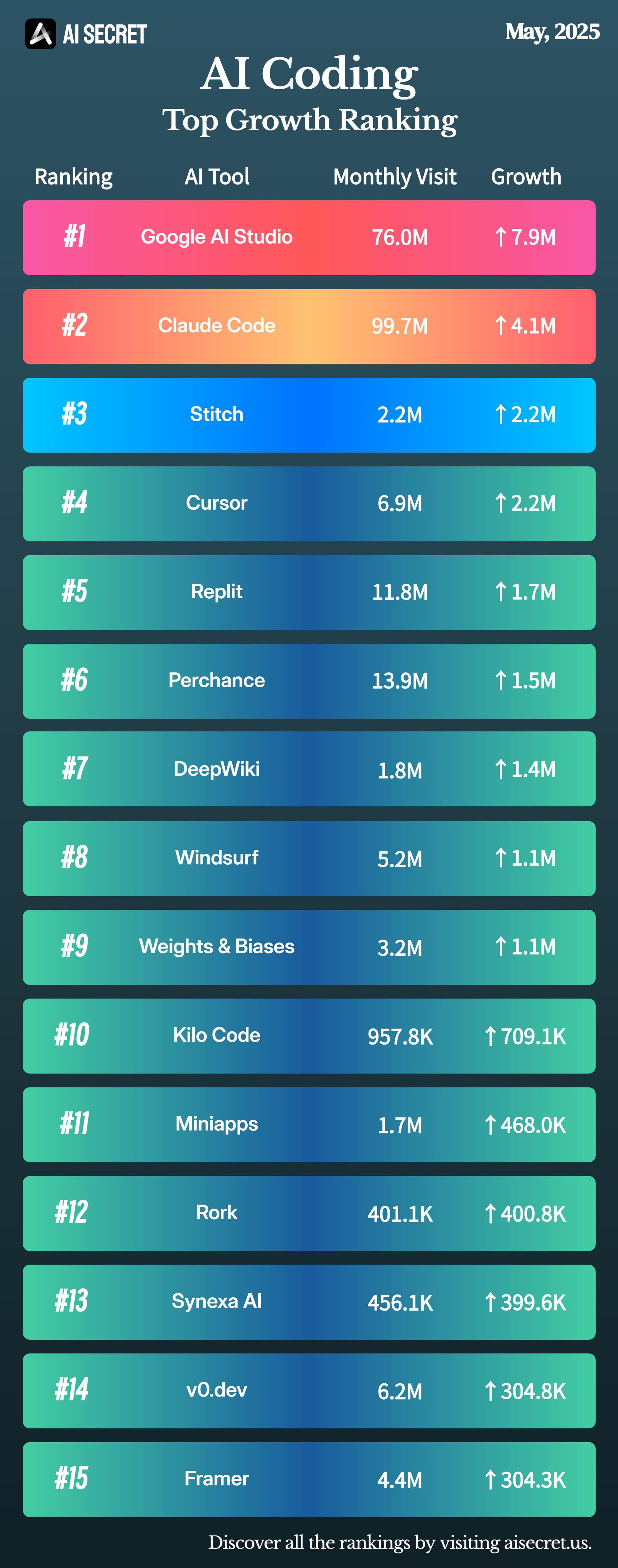
Developers continue to be among the earliest and most enthusiastic adopters of AI. In May, Google AI Studio topped the coding charts with +7.9M growth, reflecting increased usage among enterprise and open-source teams alike.
Claude Code (a specialized code generation mode from Anthropic) saw +4.1M growth, proving the demand for aligned and safe coding copilots. Meanwhile, smaller but fast-growing tools like Kilo Code (+709.1K) and Rork (+400.8K) are seeing explosive growth from bootstrappers and indie hackers.
Cursor, Replit, and Windsurf all posted strong gains, reinforcing the trend of hybrid IDEs and code-enhancing assistants taking root in dev teams worldwide.
🟢 Key Takeaway: AI in code is no longer optional—it’s foundational. Tools that offer speed, structure, and reliability are winning the builder economy.
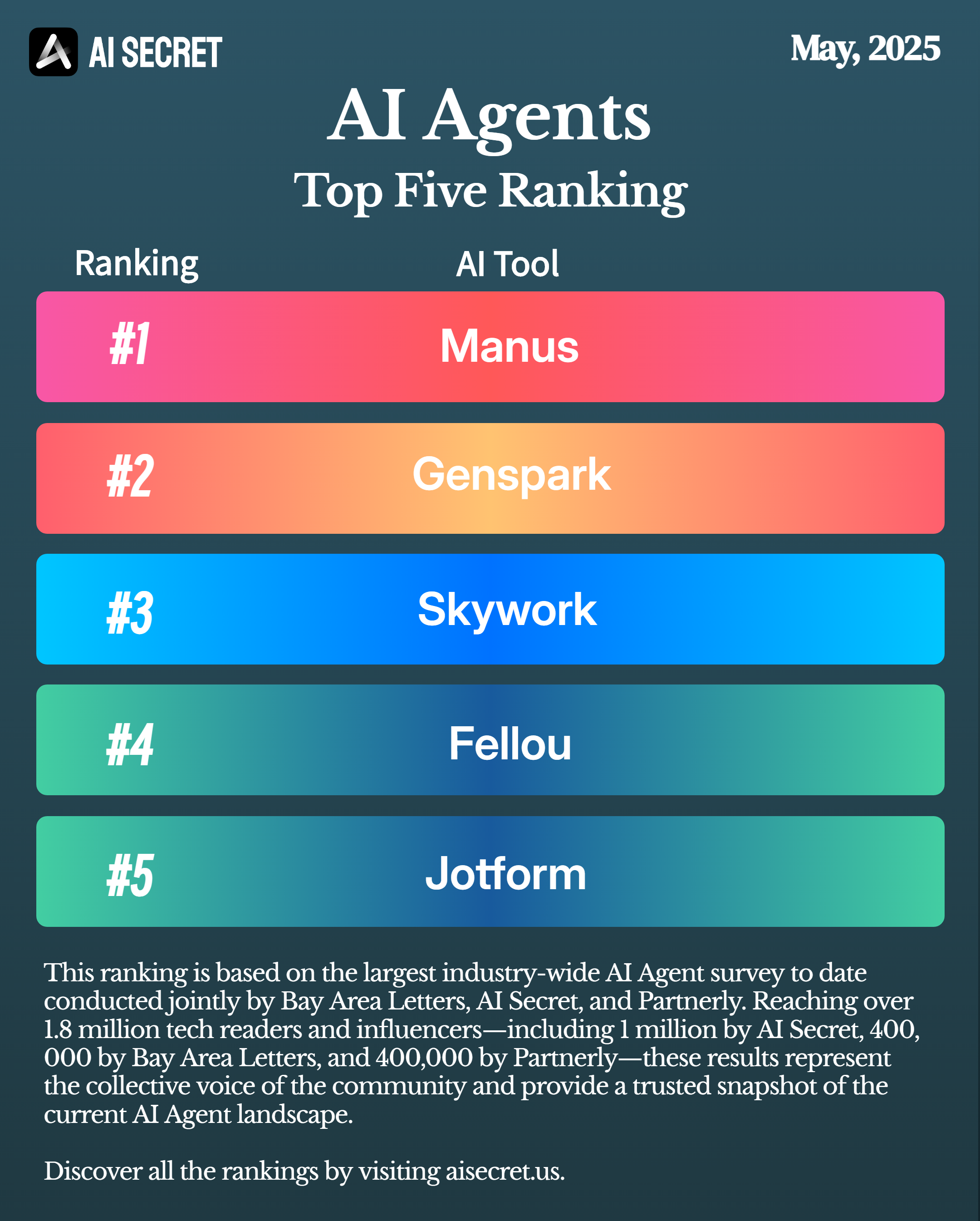
AI agents are making waves, acting as autonomous task-runners and logic-based assistants. Manus holds the top spot this month, credited with building a flexible, multi-agent orchestration system that works out-of-the-box for startups and operations teams.
Genspark, a fast-growing newcomer, is gaining traction with its AI agent design experience. Skywork and Fellou bring focus to writing, research, and daily productivity tasks.
With AI agents now capable of managing inboxes, launching ad campaigns, and analyzing documents, adoption is spreading rapidly.
🟢 Key Takeaway: We're entering the “assistant economy.” The best AI agents aren’t just smart—they’re deeply useful. Agentic AI is a new field, and the top five products chosen in this survey represent community opinions and market interest. This provides a reliable overview of the current AI agent landscape.
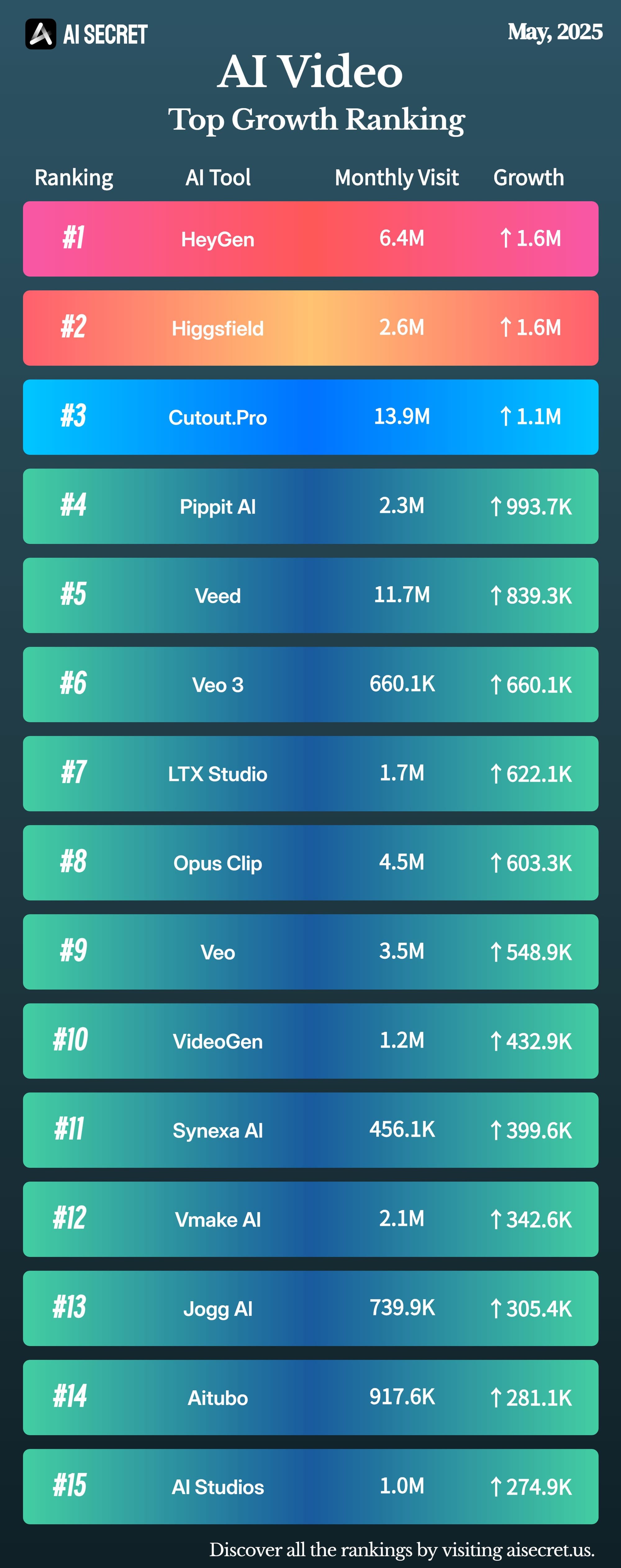
If there’s one category seeing skyrocketing innovation, it’s AI-powered video. HeyGen and Higgsfield both grew by +1.6M, with HeyGen focusing on avatar-driven explainers and Higgsfield on realism-enhanced shortform content.
Cutout.Pro continues to lead in practical utility—offering background removal, video enhancement, and editing tools for creators and ecommerce marketers.
Other breakout stars include Veo 3 (+660K), a newcomer known for cinematic generation quality, and LTX Studio, focused on storyboarding and animation. Even well-established tools like Opus Clip and Veed posted healthy gains, confirming video remains AI’s most viral medium.
🟢 Key Takeaway: The future of storytelling is AI-generated, and creators are hungry for tools that turn concepts into content—fast.
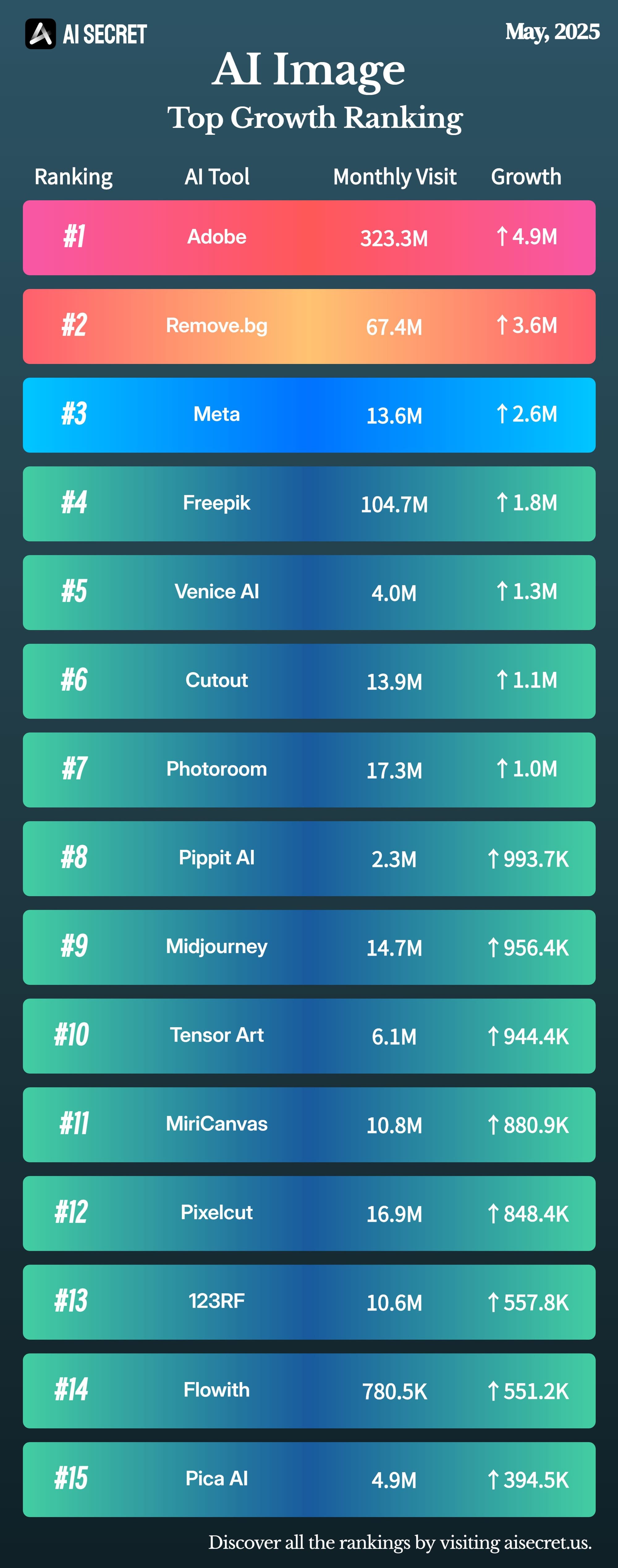
AI image tools continue to expand, merging utility and creativity. Adobe maintains dominance with +4.9M growth, driven by its native Firefly integration into Photoshop and Express. It’s proving that traditional creative platforms can win—when they move fast enough.
Remove.bg and Freepik cater to practical visual editing, while Midjourney, Tensor Art, and Pixelcut serve artists, designers, and ecom professionals looking for fast turnaround and stylistic flexibility.
Pippit AI, Flowith, and Photoroom represent the next generation: mobile-first, consumer-friendly, and ready for TikTok-era creation.
🟢 Key Takeaway: AI image tools are no longer novelty—they’re production-ready. And the competition between utility and aesthetics is heating up.
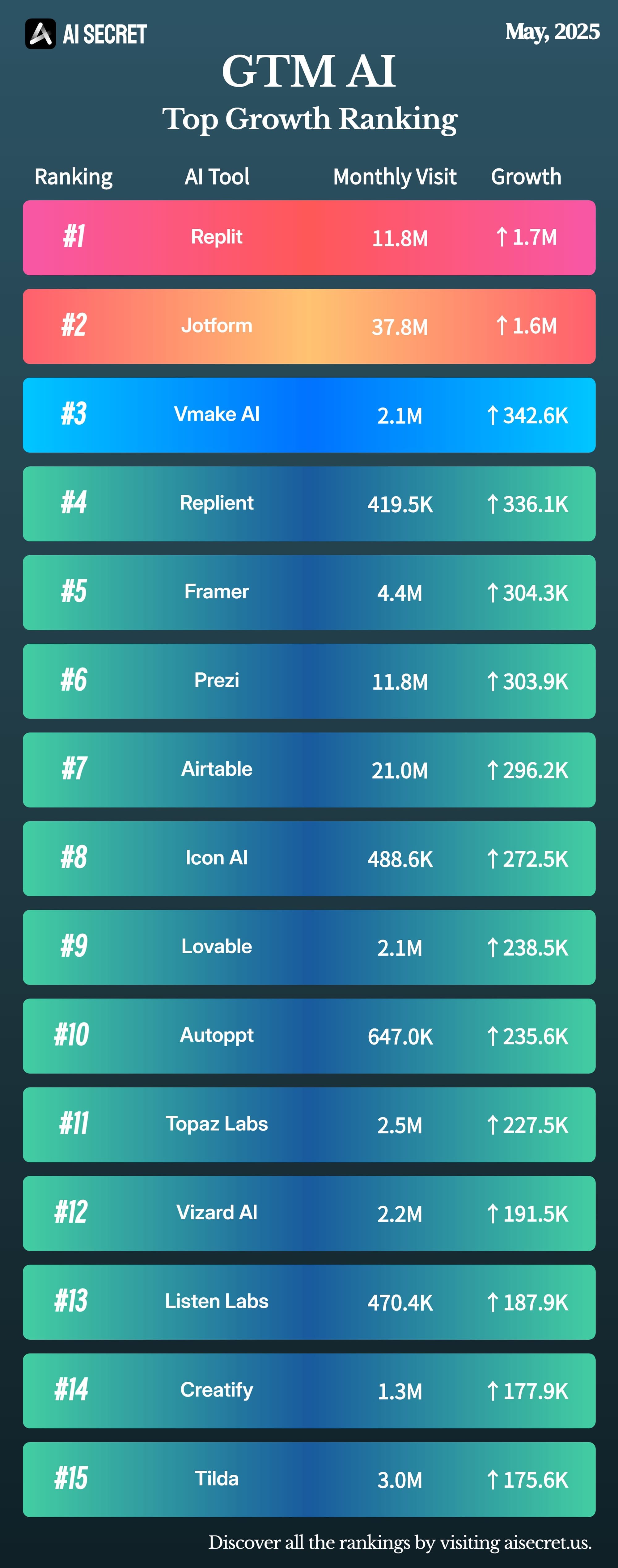
In the go-to-market (GTM) category, AI is becoming a crucial launch lever. Replit tops the chart with +1.7M growth, showing developers are embracing code-driven product creation more than ever.
Jotform, with +1.6M growth, continues to lead for form automation, landing pages, and internal ops. Tools like Framer, Vmake AI, and Prezi bridge the gap between creative marketing and scalable launch systems.
Even specialized tools like Replient and Autoppt are showing traction—proving there’s appetite for automation across every part of the GTM stack.
🟢 Key Takeaway: AI is redefining the startup stack. Product launches are faster, leaner, and increasingly automated.
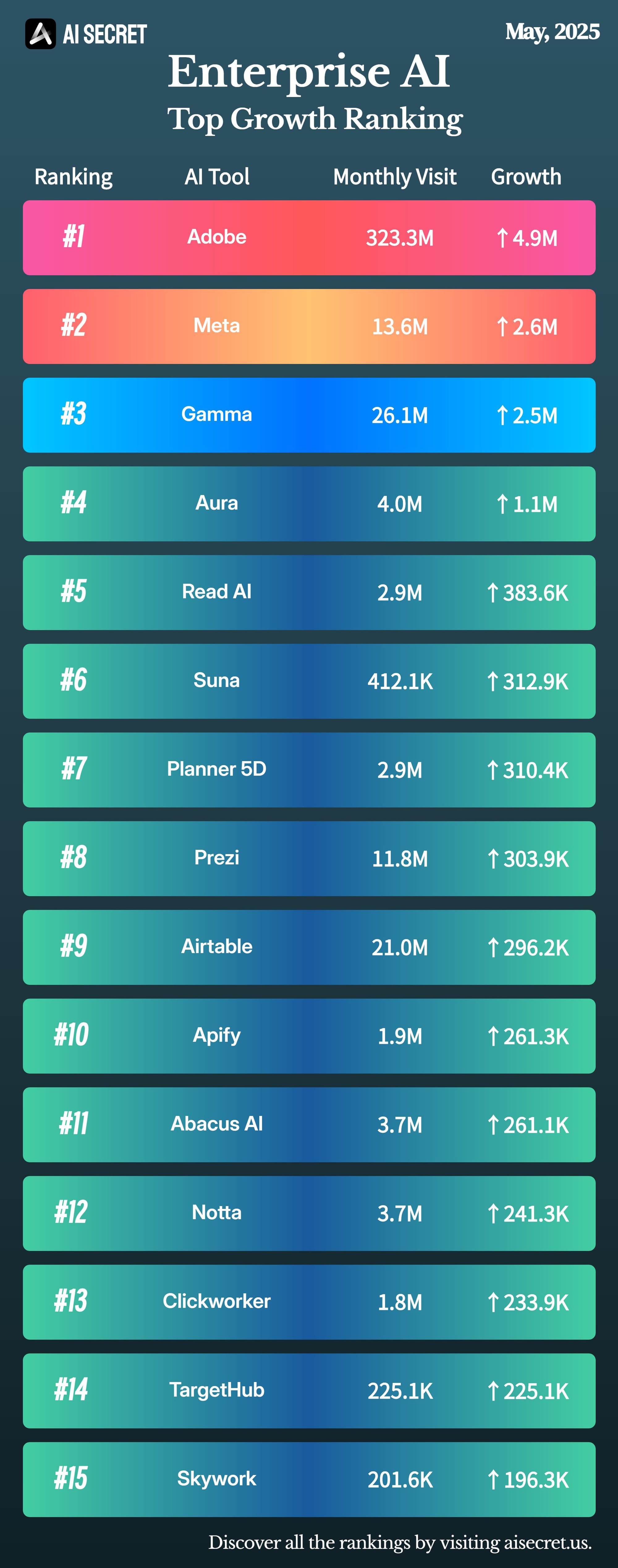
Enterprise adoption tends to move slower—but once it starts, it scales hard. Adobe and Meta once again top the rankings, but newer platforms like Gamma (+2.5M) are becoming staples in internal documentation, team communication, and enterprise design.
Aura, Read AI, Suna, and Planner 5D help with everything from meeting summaries to spatial planning. Meanwhile, Airtable, Notta, and Abacus AI show strong growth in the automation and knowledge management space.
🟢 Key Takeaway: Enterprise AI isn’t flashy—but it’s sticky. Once integrated into workflows, these tools become indispensable.
Across every category—from dev tools and agents to enterprise apps and video creators—AI usage is accelerating, diversifying, and deepening. Major platforms continue to dominate in reach, but smaller tools with strong utility and fast iteration cycles are making serious moves. As AI becomes embedded into every workflow, the line between “tool” and “team member” is blurring.
What stands out most?
As the AI stack expands, one thing is clear: the future belongs to those building fast, adapting fast, and solving real problems.
TOGETHER WITH US
AI Secret Media Group is the world’s #1 AI & Tech Newsletter Group, boasting over 1 million readers from leading companies such as OpenAI, Google, Meta, and Microsoft. Our Newsletter Brands:
We've helped promote over 500 Tech Brands. Will yours be the next?
Email our co-founder Mark directly at mark@aisecret.us if the button fails.
Latest Daily Rundowns
 Magna Ding
 Magna Ding
 Magna Ding

Latest AI Insights
Magna Magna
 Magna
According to the AI Secret Top Growth Ranking Report – June 2025, Gemini—Google’s flagship AI platform—pulled off what can only be described as the digital equivalent of a rockstar stadium
Read the storyVeo3 New Launch, Fast Fails Win, GPT's New Cart
Your syllabus just got auto-summarized—and sold
Label War, Google Billed Again, $30B Burn
A Code Rocket, Claude Factory, Scale AI Crisis
In a world where developers live and breathe in their terminals, Google has just dropped a bombshell that has the coding community buzzing louder than a
An AI Reached 2.2M Visitors in Weeks
A Comprehensive Analysis of Its Cold-Start Strategy and Growth Mechanics
Discover The Hidden Dynamics of the AI Industry
The artificial intelligence (AI) industry is no stranger to drama, but few stories have sent as many shockwaves through Silicon Valley as Meta’s jaw-dropping $14