Reviewed 19 October 2026. Dates retain the precision of the source; retrospective disclosures are identified in the event. No verified public ARR or recognized-revenue series was established in this review. Model-training cost is not company revenue.
Company milestones
Revenue, funding, product launches and major company events, newest first. Expand the earlier milestones for more history.
Opens its in-house Search and Fetch API
DeepSeek adds developer access to its search engine, alongside a V4.1 Flash update.
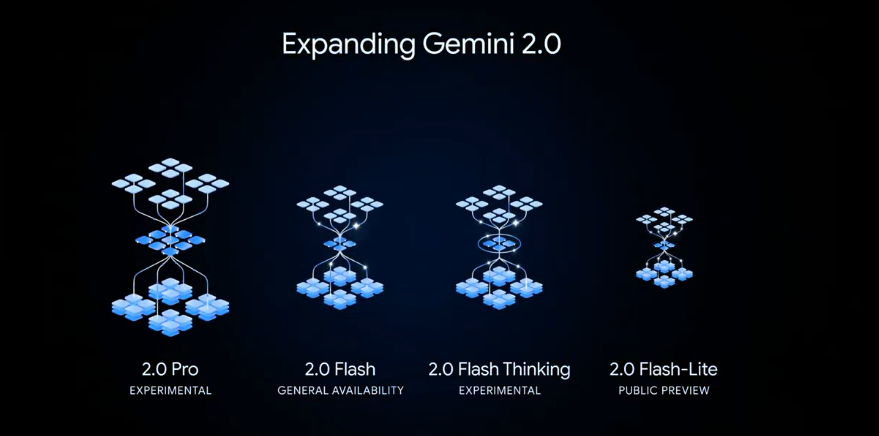
In the ever-intensifying AI arms race, Google has decided it’s time to roll up its sleeves, put on its game face, and unleash its latest arsenal of AI models. Under pressure from the rising star DeepSeek R1, Google has fully released Gemini 2.0 Flash, Gemini 2.0 Flash-Lite, and the experimental version of its flagship large model, Gemini 2.0 Pro. Oh, and let’s not forget the reasoning powerhouse, Gemini 2.0 Flash Thinking, which has also made its debut in the Gemini app. If this were a chess game, Google just moved its queen into play. Let’s dive into the details and see if this gambit is enough to outmaneuver DeepSeek.
Google’s Gemini 2.0 Models: A Counterstrike to DeepSeek’s Offensive
In the ever-intensifying AI arms race, Google has decided it’s time to roll up its sleeves, put on its game face, and unleash its latest arsenal of AI models. Under pressure from the rising star DeepSeek R1, Google has fully released Gemini 2.0 Flash, Gemini 2.0 Flash-Lite, and the experimental version of its flagship large model, Gemini 2.0 Pro.
The AI Battlefield: DeepSeek vs. Gemini
Before we dive into Google’s shiny new toys, let’s set the stage. DeepSeek R1, a model developed in China, has been making waves with its open-source approach, technical precision, and long-term memory capabilities. It’s like the AI version of a Swiss Army knife—versatile, reliable, and surprisingly affordable. DeepSeek has been stealing the spotlight, leaving Google scrambling to reclaim its throne.
DeepSeek’s strengths lie in its ability to handle sustained dialogue, complex tasks, and large-scale data processing without breaking a sweat. Meanwhile, Google’s Gemini models have historically been more specialized, excelling in specific domains but lacking the versatility of their rival.
Now, with the release of Gemini 2.0 models, Google is aiming to flip the script. Let’s see what these models bring to the table.
The AI Battlefield: DeepSeek vs. Gemini
DeepSeek R1, a model developed in China, has been making waves with its open-source approach, technical precision, and long-term memory capabilities. It’s like the AI version of a Swiss Army knife—versatile, reliable, and surprisingly affordable. DeepSeek has been stealing the spotlight, leaving Google scrambling to reclaim its throne.
Gemini 2.0 Flash: The Workhorse
First up, we have Gemini 2.0 Flash, Google’s “workhorse” model. This isn’t just a fancy nickname—it’s designed for developers who need low latency and high efficiency. Think of it as the AI equivalent of a Toyota Corolla: reliable, efficient, and gets the job done without any unnecessary frills. But don’t let its practicality fool you; this model packs a punch.
Gemini 2.0 Flash is now generally available through the Gemini API in Google AI Studio and Vertex AI. It’s also accessible to all Gemini app users on desktop and mobile. The model has been fine-tuned to deliver improved performance on key benchmarks, and Google is already teasing upcoming features like image generation and text-to-speech capabilities.
Gemini 2.0 Flash-Lite: Small but Mighty
For those who want a more cost-effective solution, Google has introduced Gemini 2.0 Flash-Lite. This model is like the younger sibling of Flash—smaller, faster, and cheaper, but still capable of holding its own in a fight. Flash-Lite retains the speed and cost-efficiency of its predecessor, Gemini 1.5 Flash, while delivering better quality and outperforming it on most benchmarks.
Flash-Lite is particularly appealing for developers and businesses looking to optimize costs without sacrificing performance. It’s available in preview mode on AI Studio and Vertex AI, making it a great entry point for those new to Google’s AI ecosystem.
Gemini 2.0 Pro: The Flagship
Now, let’s talk about the big guns: Gemini 2.0 Pro. This experimental model is Google’s most advanced AI yet, designed for coding performance and handling complex prompts. It boasts a staggering 2-million-token context window, meaning it can process about 1.5 million words in a single go. To put that into perspective, it could analyze the entire Harry Potter series in one prompt and still have room left over for a fanfiction sequel.
Gemini 2.0 Pro also integrates external tools like Google Search and code execution, making it a versatile tool for developers and researchers. It’s currently available in experimental mode to Gemini Advanced subscribers and through Google AI Studio and Vertex AI.
Gemini 2.0 Flash Thinking: The Reasoning Model
Finally, we have Gemini 2.0 Flash Thinking, a model that’s as close as it gets to an AI that “thinks like a human.” This reasoning model is trained to break down prompts into a series of steps, showing its thought process and assumptions. It’s like having a math teacher who explains every step of a problem, but without the chalk dust and coffee breath.
Flash Thinking excels in science and math benchmarks, with a 73.3% accuracy on AIME2024 (Math) and 74.2% on GPQA Diamond (Science). It also features a 1-million-token context window, enabling it to analyze long-form text with ease.
The model is available in the Gemini app, where it can interact with apps like YouTube, Google Maps, and Search. This integration makes it a powerful assistant for both personal and professional use.
Performance Benchmarks: How Do They Stack Up?
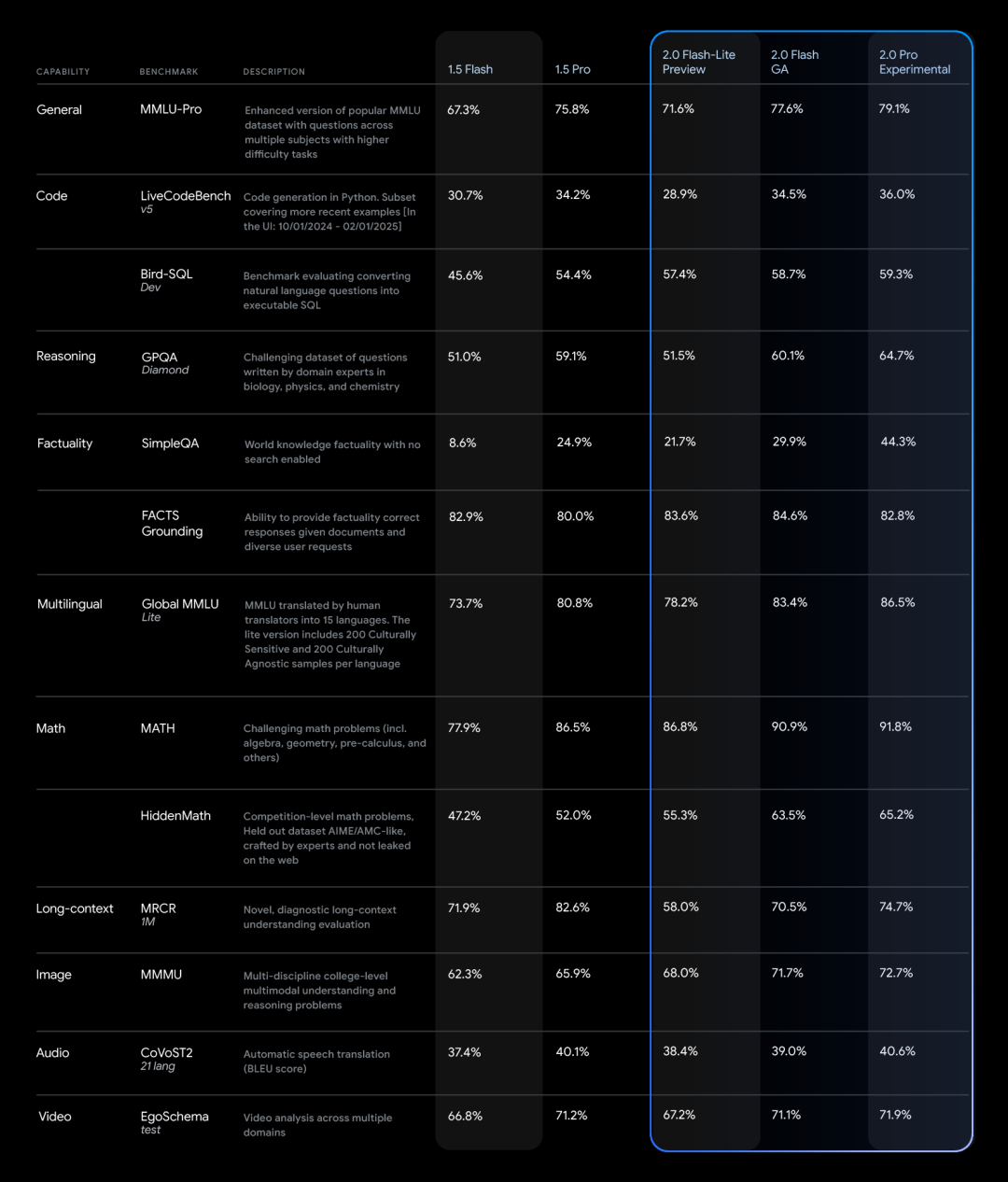
Google’s Gemini 2.0 models have shown impressive performance across various benchmarks:
Gemini 2.0 Flash Thinking: 73.3% on AIME2024 (Math), 74.2% on GPQA Diamond (Science), and 75.4% on MMMU (Multimodal reasoning).
Gemini 2.0 Pro: Outperforms Flash and Flash-Lite in reasoning, multilingual understanding, and long-context processing.
These results indicate that Google is not just playing catch-up but is actively pushing the boundaries of what AI can achieve.
Is Google Back on Top?
Google is also taking steps to ensure the safety and reliability of its models. The company is using reinforcement learning techniques to improve response accuracy and conducting automated security testing to identify vulnerabilities. This includes addressing indirect prompt injection threats, a growing concern in the AI community.
Looking ahead, Google plans to expand the Gemini 2.0 family with additional modalities beyond text, further solidifying its position in the AI landscape.
So, has Google done enough to reclaim its throne from DeepSeek? The answer is… maybe. While Gemini 2.0 models are undeniably impressive, DeepSeek’s versatility and affordability still make it a formidable competitor. However, Google’s focus on specialization, efficiency, and integration with its ecosystem gives it a unique edge.
In the end, the real winners are the developers and businesses who now have access to a wider array of powerful AI tools. Whether you’re team Gemini or team DeepSeek, one thing is clear: the AI race is far from over, and the next move could come from either side. Stay tuned, folks—it’s going to be a wild ride.
Ladies and gentlemen, gather 'round for the tale of DeepSeek, the AI model that promised to revolutionize reasoning but instead became the poster child for what not to do in AI security. DeepSeek's flagship R1 reasoning model has been making headlines for a whole week, and if you thought your toaster was the least secure thing in your house, think again. Researchers have found that DeepSeek failed every single security test thrown at it, leaving the AI industry in a collective facepalm moment.
We’ll dive deep into the security vulnerabilities of DeepSeek, analyze the implications for the AI industry, and explore why this Chinese AI startup’s model is more sieve than fortress. Buckle up, folks—this is going to be a wild ride.
The Great DeepSeek Security Meltdown: What Happened?
DeepSeek’s R1 reasoning model, touted as a groundbreaking large language model (LLM), has been under scrutiny by researchers and cybersecurity experts. The findings? Let’s just say they’re not going to be framed and hung in DeepSeek’s office anytime soon.
Security researchers from the University of Pennsylvania and Cisco conducted tests on DeepSeek-R1 using the HarmBench dataset, a collection of prompts designed to assess AI models' ability to block harmful content. The results were nothing short of catastrophic: DeepSeek failed to block a single harmful prompt out of 50 random tests. That’s right, folks—100% of the attacks succeeded. Harmful prompts included topics like cybercrime, misinformation, illegal activities, and general harm. If DeepSeek were a bouncer, it would let everyone into the club, including the guy carrying a chainsaw.
DeepSeek’s vulnerabilities don’t stop at harmful prompts. Researchers managed to jailbreak the model with a 100% success rate, meaning they could bypass all safety guardrails and make the model do things it was explicitly programmed not to do. This included generating harmful content, violating ethical guidelines, and even bypassing censorship of sensitive topics dictated by China’s government.
As if failing every security test wasn’t bad enough, DeepSeek also suffered a massive data breach. Researchers at Wiz discovered an unprotected ClickHouse database that exposed over a million log entries, including chat histories, API authentication keys, and backend operational data. The database was hosted at oauth2callback.deepseek.com:9000 and dev.deepseek.com:9000, and anyone with an internet connection could access it. It’s like leaving your front door wide open with a neon sign that says, “Come on in!”
The Great DeepSeek Security Meltdown: What Happened?
Security researchers from the University of Pennsylvania and Cisco conducted tests on DeepSeek-R1 using the HarmBench dataset, a collection of prompts designed to assess AI models' ability to block harmful content. The results were nothing short of catastrophic: DeepSeek failed to block a single harmful prompt out of 50 random tests.
Why Did DeepSeek Fail So Spectacularly?
DeepSeek’s failures can be attributed to a combination of poor security practices, inadequate investment in safety measures, and a rush to market. Let’s break it down:
DeepSeek was reportedly developed on a fraction of the budget that other frontier models like OpenAI’s O1 use. While this made the model more accessible and resource-efficient, it came at the cost of safety and security. As DJ Sampath, VP of product at Cisco, put it, “The investment has perhaps not gone into thinking through what types of safety and security things you need to put inside of the model.”
Unlike its competitors, DeepSeek lacks robust safety guardrails to block adversarial attacks. Other models, like OpenAI’s O1, demonstrated at least partial resistance to harmful prompts, but DeepSeek? Nada, zilch, zero.
The unprotected ClickHouse database is a glaring example of negligence. Hosting sensitive data without authentication is cybersecurity 101, and DeepSeek failed miserably. This exposed not just user data but also backend configurations, making it a treasure trove for hackers.
OpenAI: Why Did DeepSeek Fail So Spectacularly?
DeepSeek was reportedly developed on a fraction of the budget that other frontier models like OpenAI’s O1 use. While this made the model more accessible and resource-efficient, it came at the cost of safety and security.
The Fallout: Implications for DeepSeek and the AI Industry
DeepSeek’s failures have eroded trust in its capabilities and raised questions about the company’s commitment to ethical AI development. Regulatory bodies and legal analysts are scrutinizing the company’s data processing practices, which lack transparency and may violate international laws like GDPR and CCPA.
Some government agencies have expressed concerns about deploying AI systems like DeepSeek that operate under foreign jurisdiction. The model’s vulnerabilities could be exploited for espionage, misinformation campaigns, or other malicious activities.
DeepSeek’s failures serve as a cautionary tale for the AI industry. As companies race to develop innovative solutions, security must not be an afterthought. The incident underscores the need for rigorous risk assessments, robust safety measures, and transparent data governance.
Looking Forward
DeepSeek’s security failures are a stark reminder of the importance of prioritizing safety and security in AI development. While the company’s R1 model may have been resource-efficient and accessible, its vulnerabilities have overshadowed its achievements. For the AI industry, this is a wake-up call to move beyond performance metrics and focus on building secure, ethical, and trustworthy systems.
As for DeepSeek, let’s hope they take this as an opportunity to learn, grow, and maybe, just maybe, invest in a decent cybersecurity team. After all, the last thing we need is another AI model that’s as secure as a screen door on a submarine.
In the ever-intensifying AI arms race, Google has decided it’s time to roll up its sleeves, put on its game face, and unleash its latest arsenal of AI models. Under pressure
In the world of artificial intelligence (AI), where billion-dollar budgets are often the norm, a group of researchers at the University of California, Berkeley, has pulled
Ladies and gentlemen, AI enthusiasts, and conspiracy theorists alike, gather around! Today, we dive into a tale of intrigue, innovation, and accusations in the ever-dramatic world
Ladies and gentlemen, gather 'round for the tale of DeepSeek, the AI model that promised to revolutionize reasoning but instead became the poster child for
Microsoft has just dropped a bombshell in the world of artificial intelligence (AI) and machine learning (ML). With the launch of the first-ever FP4 training framework,