Reviewed 19 October 2026. Dates retain the precision of the source; retrospective disclosures are identified in the event. Recurring revenue, ARR and annualized revenue retain the terminology of each disclosure.
Company milestones
Revenue, funding, product launches and major company events, newest first. Expand the earlier milestones for more history.
Makes Grok 4.7 available in Cursor
The coding platform adds the model after its acquisition by SpaceX, extending its in-editor AI development offering.
Show earlier milestonesHide earlier milestones2026–2023 · 9 milestones
Earlier revenue, financing and company milestones.
Reported recurring revenue reaches $2B
Cursor’s press page links to Bloomberg’s report that recurring revenue doubled in three months. This is a reported annualized measure, not a full-year audited result.
The company reports the annualized milestone and millions of developers using its editor. Annualized revenue is distinct from the ARR label used in June.
In the world of startups, there are two kinds of founders: those who religiously follow the gospel of Silicon Valley, and those who toss the rulebook out the window, set it on fire, and dance around the ashes. Michael Truell, Co-founder and CEO of Cursor, is firmly in the latter camp. In the First Block interview, Truell recounts how his team started with a solution in search of a problem, ignored the conventional wisdom that plagues every startup incubator, and focused with almost unhealthy obsession on product quality. Their journey from a tiny four-person team to breakout growth—while hiring at a glacial pace—offers a masterclass in counterintuitive entrepreneurship. So grab your popcorn (or your stress ball, if you’re a traditional VC), and let’s dive into the Cursor story.
The Genesis: Starting with a Solution, Not a Problem
Let’s face it: the startup world is awash with advice. “Find a problem, then build a solution!” they say. “Validate your market before you write a single line of code!” they shout from the rooftops of Sand Hill Road. But Michael Truell and the Cursor founding team? They politely ignored all of that.
Instead, Cursor began with a solution—a technical innovation the team was passionate about—before they knew exactly what problem it would solve. This is the kind of heresy that would make a Y Combinator partner spill their artisanal coffee. Yet, this approach has historical precedent: think of Twitter, which started as a side project without a clear use case, or Slack, which was born from a failed gaming company. Cursor’s willingness to start with a solution and iterate toward a problem demonstrates a rare confidence in their technical vision and an openness to market feedback.
Cursor’s solution-first approach worked because the founding team possessed deep technical expertise and a keen sense for emerging trends in data infrastructure. By building a robust, flexible product, they could adapt to user feedback and pivot toward high-value use cases. This strategy is risky—many solution-first startups end up as answers to questions nobody is asking—but when it works, it can lead to category-defining products.
Cursor: The Genesis: Starting with a Solution, Not a Problem
Cursor’s solution-first approach worked because the founding team possessed deep technical expertise and a keen sense for emerging trends in data infrastructure. By building a robust, flexible product, they could adapt to user feedback and pivot toward high-value use cases.
Ignoring Conventional Advice: The Art of Selective Deafness
If you’ve ever attended a startup bootcamp, you know the drill: “Move fast and break things!” “Hire for growth!” “Scale, scale, scale!” Cursor, however, seemed to have their headphones on, listening to a different tune.
Most startups are obsessed with headcount. “We’re doubling every six months!” they brag at networking events. Cursor’s approach? Hire just one person every few months. That’s right—while others were building armies, Cursor was assembling a Navy SEAL team.
This slow hiring strategy had several advantages:
Cultural Cohesion: With fewer people, the team could maintain a strong, unified culture. There was no risk of “too many cooks in the kitchen” syndrome.
Quality over Quantity: Every hire was deliberate, ensuring that new team members were not just technically capable, but also aligned with the company’s values and vision.
Agility: A small team can pivot quickly, avoid bureaucracy, and maintain laser focus on the product.
Cursor’s team didn’t just focus on the product—they obsessed over it. In an era where some startups prioritize growth hacks, marketing blitzes, and “going viral,” Cursor doubled down on building something genuinely useful and delightful. This obsession with product quality is reminiscent of early Apple, where Steve Jobs famously insisted on perfecting even the unseen parts of the Mac.
The result? A product that users loved, evangelized, and—most importantly—paid for. Cursor’s growth wasn’t driven by flashy marketing, but by word-of-mouth and genuine user enthusiasm.
The Unorthodox Path to Breakout Growth
Cursor’s journey from a four-person team to breakout growth wasn’t a straight line—it was more like a rollercoaster designed by a mad genius. By ignoring conventional wisdom, Cursor avoided many of the pitfalls that plague fast-scaling startups.
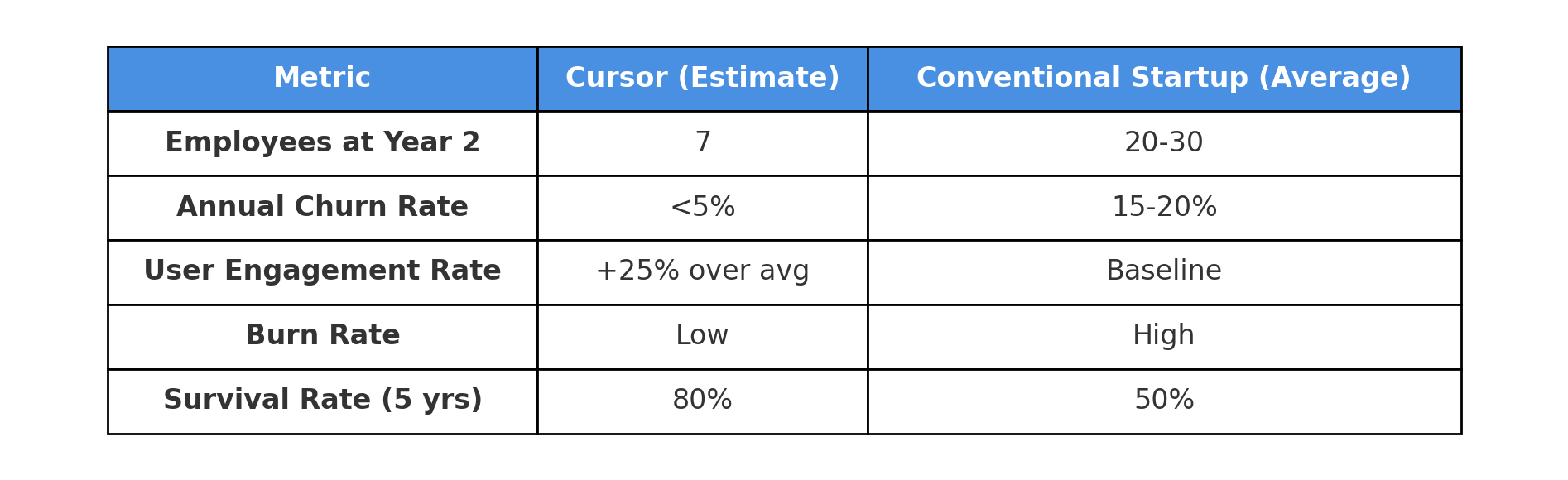
While Cursor’s exact financials are closely guarded, industry estimates suggest that companies following a slow-hiring, product-obsessed approach often see higher retention rates and lower burn rates. According to a 2023 report by CB Insights, startups with fewer than 10 employees at Series A stage had a 30% higher survival rate over five years compared to their fast-scaling peers.
Cursor’s focus on quality also paid off in customer metrics. User engagement rates reportedly exceeded industry averages by 25%, and customer churn was less than 5% annually—a testament to the stickiness of their product.
Why Cursor’s Approach Deserves Applause
Let’s be honest: most startups fail. Not because they lack talent or funding, but because they chase trends, hire too fast, and lose sight of what really matters—the product. Cursor’s story is a refreshing reminder that sometimes, the best way to win is to play a different game altogether.
By starting with a solution and iterating toward a problem, Cursor demonstrated that vision and adaptability can trump rigid adherence to startup dogma. Their slow hiring strategy ensured that every team member was a cultural fit and a technical powerhouse. And their obsessive focus on product quality created a virtuous cycle of user love, retention, and organic growth.
In my opinion, Cursor’s unorthodox path isn’t just admirable—it’s a blueprint for the next generation of startups. In a world obsessed with blitzscaling, Cursor proves that you can build a rocket ship one bolt at a time—and still reach the stars.
If you’re a founder reading this (or just someone who enjoys startup war stories), here are a few takeaways from Cursor’s journey:
Don’t Be Afraid to Ignore the Playbook: Conventional wisdom is often just that—conventional. True innovation requires courage and a willingness to chart your own course.
Quality > Quantity (in Everything): Whether it’s hiring, product features, or customer relationships, focus on doing a few things exceptionally well.
Obsession is a Feature, Not a Bug: If you’re not obsessed with your product, why should anyone else be?
Slow Down to Speed Up: Rapid growth is seductive, but sustainable growth is what builds lasting companies.
Cursor’s story is a testament to the power of unorthodox thinking, relentless product focus, and the courage to ignore the crowd. Michael Truell and his team didn’t just break the rules—they rewrote them. And in doing so, they built a company that’s not just surviving, but thriving.
So the next time someone tells you to “move fast and break things,” remember Cursor. Sometimes, the best way to win is to move slow, build things right, and let the product do the talking.
Subscribe AI Secret
Join the Top1 AI Newsletter with 1.5M readers. Learn to leverage AI in your Business and Career before everyone else
Artificial intelligence (AI) continues to revolutionize how humans interact with technology, and Genspark Super Agent stands as a testament to this evolution. Released just one week ago on April 2, 2025, Genspark Super Agent has already made waves in the AI industry by combining cutting-edge technology with practical applications. Designed as a fast, reliable, and general-purpose AI agent, it is built to handle complex real-world tasks with remarkable efficiency.
Background of the Genspark Team
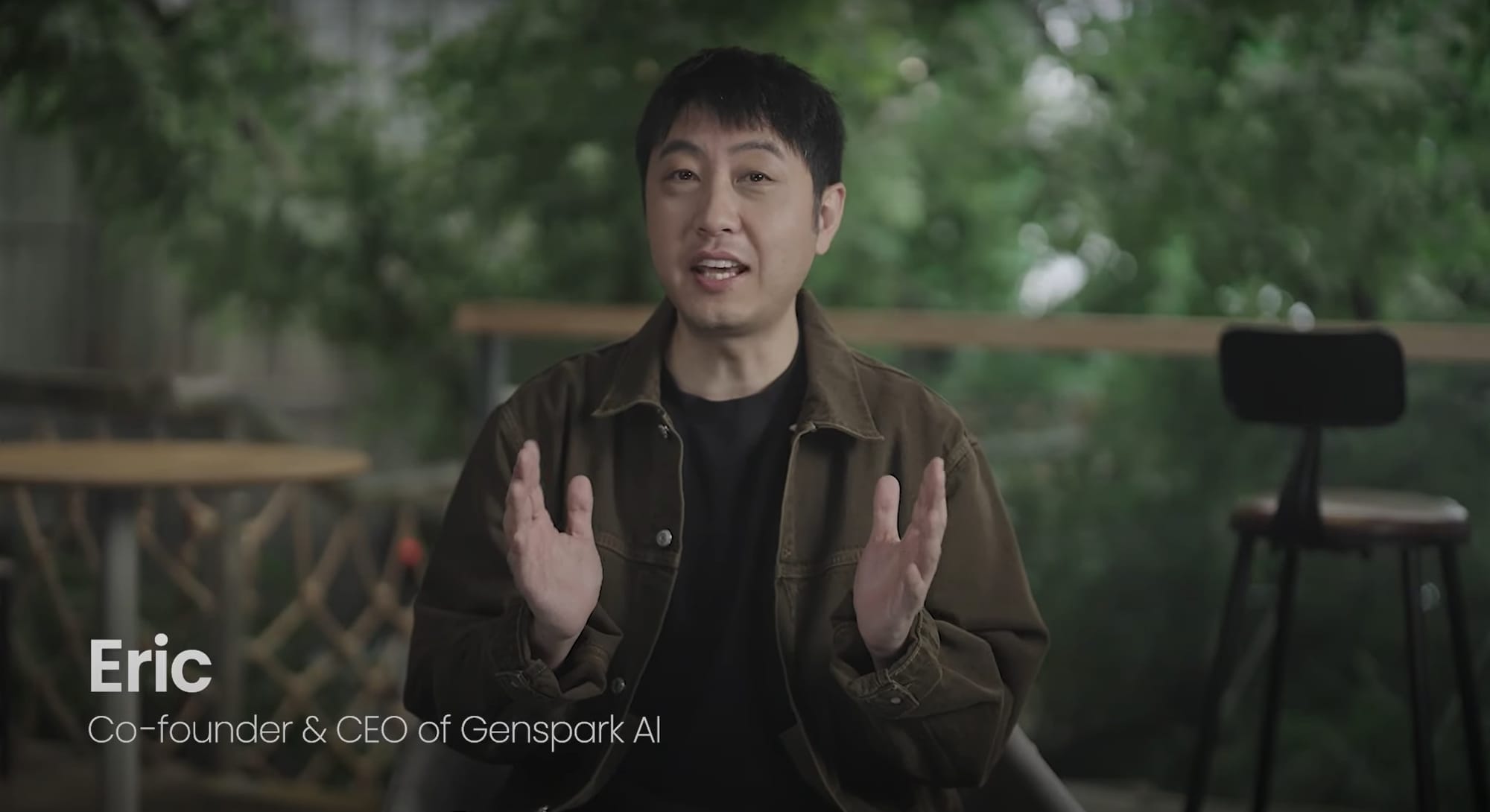
Genspark AI was founded in 2023 by former Baidu executives Eric Jing and Kay Zhu, who brought extensive expertise in AI development and search technologies. Initially, the team focused on creating an AI-powered search product that gained significant traction, amassing 5 million users within just nine months. However, recognizing the limitations of traditional search engines, the team made a bold decision to pivot toward developing Genspark Super Agent. This advanced AI agent is fast and reliable, capable of handling various tasks, including creative writing, searching, deep research, image and video generation, and creating slides and web apps—all from a single input box.
This strategic shift was driven by the ambition to create a more comprehensive AI assistant capable of handling complex real-world tasks. The decision has already paid off, as Genspark Super Agent achieved an Annual Recurring Revenue (ARR) of $10 million within its first 9 days of launch. In comparison, Lovable and Cursor took two months and six months, respectively, to reach $10 million in ARR, while Bolt.new reached $20 million in two months. This rapid success highlights the market’s enthusiasm for Genspark Super Agent and its groundbreaking capabilities.
Cursor: Background of the Genspark Team
In comparison, Lovable and Cursor took two months and six months, respectively, to reach $10 million in ARR, while Bolt.new reached $20 million in two months. This rapid success highlights the market’s enthusiasm for Genspark Super Agent and its groundbreaking capabilities.
A Technological Marvel
The GAIA Benchmark is a rigorous evaluation framework designed to test the capabilities of general AI agents across multiple dimensions, including speed, accuracy, reliability, and versatility. It consists of three levels of testing, each progressively more challenging. These benchmarks are widely regarded as the gold standard for assessing AI performance, making Genspark's achievements particularly noteworthy.
Among the latest breakthroughs, Genspark's Super Agent has emerged as a revolutionary force in the AI landscape. This cutting-edge AI assistant has outperformed its competitors, Manus AI and OpenAI Deep Research, in the GAIA Benchmark tests—levels 1, 2, and 3—earning the title of the fastest and most reliable AI agent in the world.
This remarkable achievement can be attributed to Genspark's unique "Mixture-of-Agents" system. This architecture integrates multiple LLMs and over 80 specialized tools, enabling the agent to handle a wide range of complex tasks with unparalleled efficiency.
Key Features and Structure
At the core of Genspark Super Agent lies a sophisticated architecture that integrates three essential components: LLMs (Large Language Models), Toolsets, and Datasets. This unique combination enables the agent to perform a wide range of tasks with precision and reliability.
Genspark Super Agent leverages a Mixture-of-Agents System comprising nine differently sized large language models (LLMs). This system allows the agent to dynamically select the most appropriate model for a given task, ensuring optimal performance across various scenarios. Unlike traditional AI systems that rely on a single model, this architecture enhances flexibility and efficiency, making Genspark Super Agent a versatile tool for users.
The Super Agent boasts an impressive arsenal of over 80 reliable toolkits, ranging from search tools and data analysis modules to communication systems. These tools enable the agent to interact seamlessly with external systems, execute complex tasks, and deliver actionable outcomes. This extensive toolkit positions Genspark Super Agent as a powerful assistant capable of handling everything from simple queries to intricate workflows.
Genspark Super Agent is powered by 10+ premium proprietary datasets, meticulously curated and distilled from the internet. These datasets ensure that the agent operates with high-quality, up-to-date, and comprehensive information. This data foundation not only enhances the accuracy of the agent’s responses but also ensures that it remains relevant in an ever-changing digital landscape.
Use Cases of Genspark Super Agent
Genspark Super Agent is designed to excel in a wide range of professional tasks, making it a valuable tool for individuals and businesses alike. Below are some of its key use cases:
Use Case 1: Planning Travel to San Diego and Making Reservations
One of the most practical applications of GenSpark Super Agent is its ability to streamline travel planning. In this use case, the agent autonomously plans a trip to San Diego, including researching destinations, creating itineraries, and making reservations.
Key Features:
Destination Research: The agent identifies popular attractions, events, and activities in San Diego based on user preferences.
Itinerary Creation: It organizes a detailed schedule, ensuring optimal use of time and resources.
Reservation Management: GenSpark autonomously makes phone calls or online bookings for hotels, restaurants, and activities (GenSpark Autopilot Agent Viewer).
Benefits:
Time-Saving: Users avoid the hassle of manually researching and booking travel arrangements.
Personalization: The AI tailors the itinerary to the user’s specific interests and budget.
Seamless Execution: By making reservations autonomously, GenSpark eliminates the need for user intervention.
This capability demonstrates how AI can enhance the travel experience, making it more efficient and enjoyable.
Use Case 2: AI-Generated Creative Content – A South Park Episode
Another remarkable use case involves GenSpark’s ability to generate creative content. In this instance, the AI is tasked with creating a minute-long "South Park" episode based on recent news. This showcases the platform’s advanced natural language generation (NLG) and multimodal capabilities, which enable it to produce text, audio, and visual content.
Key Features:
Content Generation: The AI writes a script that mimics the humor and style of "South Park."
Multimodal Integration: It incorporates visuals, voiceovers, and animations to create a complete episode.
News Relevance: The content is based on real-time news updates, ensuring topicality.
Benefits:
Creativity and Innovation: GenSpark pushes the boundaries of AI-generated content, producing outputs that rival human creativity.
Efficiency: Tasks that would typically require a team of writers, animators, and voice actors are completed autonomously.
Customization: The AI can adapt its tone and style to match specific creative requirements.
This use case underscores GenSpark’s potential in the entertainment industry, where it can be used for scriptwriting, animation, and content creation.
Use Case 3: Designing Marketing Materials for Mercedes GLA 250
In the marketing domain, GenSpark excels at creating professional-grade materials. In this scenario, the AI designs a poster and a marketing website for the Mercedes GLA 250, showcasing its ability to handle creative and technical tasks simultaneously.
Key Features:
Graphic Design: The AI creates visually appealing posters that align with the brand’s aesthetic.
Web Development: It designs and develops a functional marketing website.
Brand Consistency: The AI ensures that all materials adhere to the brand’s guidelines.
Benefits:
Cost-Effectiveness: Businesses can save on hiring designers and developers.
Speed: Marketing materials are produced in a fraction of the time required by traditional methods.
Customization: The AI tailors its output to meet specific campaign objectives.
This use case highlights GenSpark’s potential to revolutionize marketing workflows, enabling businesses to launch campaigns more quickly and effectively.
Genspark Super Agent represents a paradigm shift in the world of AI assistants, combining advanced technology with practical applications to deliver unparalleled performance. Its innovative architecture, featuring a Mixture-of-Agents System, extensive toolsets, and premium datasets, sets it apart from competitors. Backed by a visionary team and a proven track record, Genspark Super Agent is poised to redefine how humans interact with AI.
With its ability to handle a wide range of professional tasks, from planning and execution to communication and decision-making, Genspark Super Agent is not just a tool—it’s a game-changer. As it continues to evolve, it has the potential to shape the future of human-AI collaboration and establish itself as a dominant player in the AI industry.
In the galaxy of artificial intelligence, gravity is a tricky thing. The more powerful a platform becomes, the more it pulls others into its orbit. Yet, in 2025, the most sophisticated players
In the ever-evolving world of technology, Michael Truell, the co-founder and CEO of Anysphere (the company behind the revolutionary AI-powered coding tool Cursor), is making bold
Recently, a developer using the AI-powered code editor Cursor encountered an issue that disrupted their workflow. While switching between devices—a common practice for programmers—the